
Jeff Carreira: You’ve had a long and successful career as both a physicist and a writer of science and science fiction. What was it that captivated you about physics in the first place and how did you make a career of explaining complicated scientific ideas in books that are accessible to the non-scientist?
John Gribbin: I started out by reading science fiction, the kind known as “hard” science fiction, by people like Arthur Clarke and Isaac Asimov, with stories based on extrapolation of real science. This was when I was about eight. This led to reading about science, and eventually to studying physics and astronomy. I wasn’t good enough at research to get a job in science (I actually had a short and modest career), so I shifted sideways into science journalism, then books. Part of the appeal was the hope to learn a little bit about a lot of things, whereas in research science you learn a great deal about a tiny subject. And it meant I could get paid while learning about things that fascinated me, like quantum physics – as long as I could translate enough of the complications for other people to join in the fun.
Jeff Carreira: Whenever physicists offer speculations about the nature of reality implied by scientific observation they encounter the criticism of having crossed over from physics to metaphysics. Can you speak to the role of ontological speculation in physics? How necessary is it? What are the dangers of it?
John Gribbin: Can I cheat by answering that question from the point of view of a reader (and writer) of science fiction? In my experience, the kind of speculative thinking involved in science fiction is the same as that involved in scientific research, but the scientist actually has to test the ideas and see if they work. So, I think that there is a similar situation with metaphysics (unproven and maybe unprovable) and physics (testable). But the boundary keeps moving as physics finds new ways to test things. To take a trivial example, the idea of continental drift was once speculation, but can now be measured using lasers from satellites. Yesterday’s metaphysics is tomorrow’s physics, and without speculation we wouldn’t get very far. The big questions in both cases are “where do we come from?”, and “how did we get here?” Those are recurring themes in my books, although not always explicitly stated. Then there is “where are we going?!”
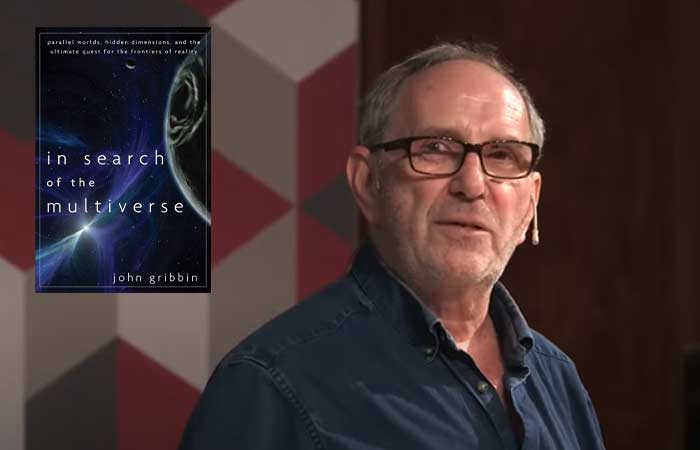
Jeff Carreira: Years ago I read your book The Search for Schrodinger’s Cat: Quantum Physics and Reality and more recently I became utterly captivated by your book In Search of the Multiverse: Parallel Worlds, Hidden Dimensions, and the Ultimate Quest for the Frontiers of Reality. Can you tell us a little about the scientific history of the theory of the multiverse and how it developed out of the Many Worlds Interpretation of quantum physics?
John Gribbin: Phew! Well, It took me a whole book to tackle that question. The idea of alternative realities, or parallel worlds, goes back at least to 1930s science fiction, and it was suggested in the context of quantum theory by Erwin Schroedinger in a lecture in the early 1950s. But nobody noticed that, and a few years later Hugh Everett published a version of what we now call the Many-Worlds Interpretation of Quantum Mechanics (MWI) which attracted a bit more attention. The essence of this scientific approach is that quantum theory tells us that all possible outcomes of an event at the quantum level are equally real, so that, for example, in the famous cat parable an experiment in which there is a 50:50 chance of a cat being killed is explained by there being one universe in which the cat dies and one in which it lives. Scale this up to every outcome of every “choice” and you have the Multiverse.
Jeff Carreira: Over the past few decades the idea that reality is made up of many universes has grown in credibility among an increasing number of people including prominent scientists and mathematicians. Can you explain why more and more people are finding this idea not only plausible, but probable, and maybe even inevitable?
John Gribbin: The key reason that people now take the Multiverse seriously is that it offers an explanation for how quantum computers work. For the details, check out the work of the Oxford theorist David Deutsch. But in essence, he says that a computer operating on quantum principles is comparing data from all, or many of, the components of the Multiverse at once. A quantum computer with, say 1,000 bits is equivalent to a conventional computer with 2 to the power of 1,000 bits, because it operates in a thousand universes at once! There are also connections with some of our fundamental ideas in cosmology, notably a model called “eternal inflation”, which envisages an infinite, eternal expanding spacetime, with no edge in space and no beginning in time, in which there are local bubbles; our entire visible universe would be one of those bubbles.
Jeff Carreira: In your book you speak about the two most likely scenarios that would lead to a multiverse. One is the emergence of a civilization that develops the capacity to create black holes that produce new physical universes, the other is the emergence of a civilization that develops the capacity to create computer-simulated universes. Can you describe these two scenarios and explain which one you find most plausible?
John Gribbin: Actually the first scenario could occur naturally. Every time a black hole forms, it opens up a new spacetime, with dimensions in some sense at right angles to all our dimensions of space and time, making a new universe. And black holes within that universe will make more universes, and so on indefinitely. This seems highly plausible. But I only discussed computer simulations to show how implausible they are. This would require infinite precision in specifying things like the position of an atom, and quantum uncertainty says that such a thing is impossible. For the same reason, although you could make a universe, by making a black hole, you could never be certain how that universe would develop. Greg Benford wrote a lovely fiction about this. See here.
Jeff Carreira: The idea of the Multiverse is moving out of the pages of science fiction and into scientific credibility, but an idea this strange and difficult to prove begs the question, what difference does it make if it is true? Besides satisfying our curiosity, are there other advantages to justify all of the research being done to prove and understand the Multiverse theory?
John Gribbin: Back to quantum computing! Deutsch will tell you that the fact that quantum computers work proves the reality of the Multiverse, and if they are developed on a large scale it will represent a leap as great as from the abacus to the most sophisticated conventional supercomputer. And “all this research” is really more of a hobby by theorists, with no significant financial cost or use of material resources, compared with things like particle accelerators and space probes. I think at the very least we can regard it as entertainment, as useful as poetry or movies. This is the bottom line about how I regard my “work” – I am an entertainer. I write about science fact that sounds like fiction, and I write science fiction based on sound scientific fact. A childhood dream come true!
Interviews

Artificial Intelligence and the Evolution of Consciousness
Interview with Steve McIntosh
Presence Cannot Be Simulated
Interview with Charles Eisenstein
Beyond the Creative Glass Ceiling
Interview with E. J. Gold and Claude Needham
“I Feel Responsible”: The Challenges of Bringing AI to Ethiopia
Interview with Mekdes Asefa
AI and the Future of Our Classrooms
Interview with Amy EdelsteinBook Reviews

A Summary of the Fetzer Institute’s Sharing Spiritual Heritage Report: A review by Ariela Cohen and Robin Beck
By Ariela Cohen

Choosing Earth, Choosing Us: Book Review of Choosing Earth
By Robin Beck

Everything, Everywhere, All at Once: Movie Review
By Jeff Sullivan
Monk and Robot: Book Review of A Psalm for the Wild-Built
By Robin Beck