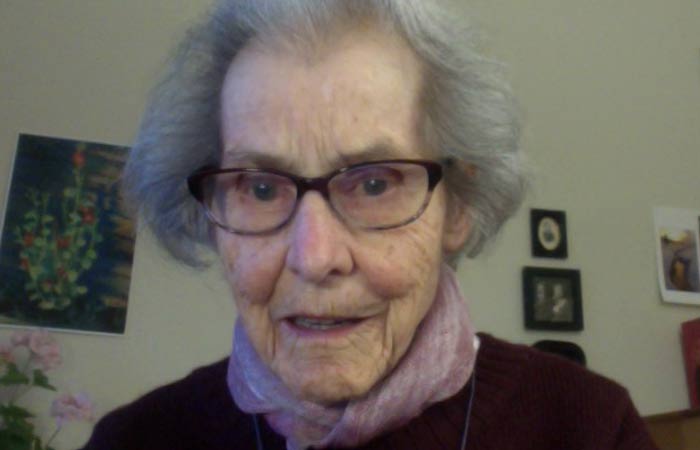

At the age of four, I was let loose to play in the huge garden that surrounded the finishing school my family was running. That was in Neuchâtel, Switzerland, in 1937. I had no siblings and no friends, so I made up stories for my dolls. I probably drifted off into alternate realms as well, for I remember the day when I tried to cross my eyes and the magic was gone. I couldn’t bring it back.
Big changes began to happen: WWII broke out, my parents divorced, and I was sent to live with my maternal grandparents near Lucerne. There was a large park-like garden there and I continued my outdoor games, befriending snails and climbing trees. When I started first grade in that staunchly catholic region, I attended catechism with my classmates. I learned to cross myself, struggled to memorize the Hail Mary prayer, and treasured the holy pictures that the priest handed out. I felt safe, having a saint in my apron pocket. However, the divorce decree stipulated that I was to be raised protestant. No more saints in my pocket! And yet another layer of otherness was added to my experience.
In order to keep me with her, my mother became manager of a children’s home, this one in a small village high in the Alps. Once again, I had to adjust: to a one-room village school and religious instruction by a saintly old pastor who had fled Hitler’s Germany and found safety among the peasants. His sermons were too scholarly for me or the village folk, but the depth of his faith touched us all. When I contracted scarlet fever and spent six weeks in a special ward at the valley hospital, he was the only visitor who bothered to come and stand below my window for a quick greeting. My mother was not allowed to leave her post.
I recovered, but the doctor ordered a tonsillectomy. A few months later, on the way home from our vacation, my mother dropped me off at the hospital in Chur. She arranged for my trip home after the surgery, then left to resume her duties. Tonsillectomies were a routine procedure in those days, and I was eleven and considered a big girl.
The next morning, in a crowded little room, surrounded by masked people, I was told to sit on the assistant’s lap. To make sure I would not move, he clamped his legs around mine and held my arms back tightly. Meanwhile the nurse was layering rags into a kind of sieve, and I watched as she poured chloroform into it. “Take a deep breath,” she said, pressing the contraption into my face.
Instantly I felt myself falling; not through a tunnel exactly, but down a tube that reminded me of the rifle barrel my uncle had shown me a few days earlier. When I emerged, there was nothing but light, intense, brilliant, wonderful light. And facing me, standing tall, was what I came to call a “light being.” I found myself flooded with love and ablaze with light, wanting nothing more than to remain there. This was home; it’s where I belonged!
When I came to I blurted out that I had just seen Jesus. Even in my foggy condition, I knew enough to speak using the name of Jesus to remain within the recognizable boundaries of the people around me. But, in fact, I had not seen Jesus. I had seen my Self, my true Self — something far more magical than I could describe. Judging from the lack of reactions from the staff, even the mention of Jesus may have been too much. No one spoke. They probably just chuckled behind their masks. I knew then to keep this secret to myself.
Being an outcast didn’t bother me too much anymore. I was used to that. No matter where I went, I never fit in. But as long as I had access to nature, especially the beautiful Alpine region, I was happy.
When we moved to Locarno, at the southern tip of Switzerland, another wondrous new world opened up to me: lakeshores with a rich subtropical flora, and culturally rich valleys surrounded by high mountains. As a teenager, I was joined by Max, the son of a refugee family my mother had befriended. Together, we explored the region on our bicycles. Max later became my husband, and in 1958 we emigrated to the United States. We settled in Colorado, at the foot of the Rocky Mountains. For the next 20 years, while raising our boys, we explored the high country by Jeep using old mining roads. Nature was always our true home and we wanted our children to grow up with a deep understanding of the natural world.
My near-death experience stayed with me, however, and became my guiding light. I knew there was a great mystery beyond the known world and I longed to discover it. When New Age teachings burst onto the scene in the seventies, I was ready. I joined a group that gathered regularly to listen to taped workshops by Patricia Sun, a beloved mystic who boldly declared that mankind was in the midst of an evolutionary leap, and that we had entered the age of avatars. She used that Sanskrit word with its original meaning: a divine incarnation in human form, a holy person or great teacher. I also attended workshops offered by the Love Project and other consciousness-raising groups. This in turn led me to enroll in massage school and explore different approaches to healing work. I felt compelled to push on, even though it broke up our marriage. The boys were away at school by then, and I was finally free.
I had been immersed in A Course in Miracles for about 4 years when I met Jay, a fascinating young man with well-developed psychic abilities. By then I had become annoyed with the masculine tone of A Course in Miracles, so when Jay introduced me to Wicca, I embraced it as a liberating step. Wicca draws upon a diverse set of ancient pagan and 20th century hermetic motifs, and the Wiccans typically worship a goddess and a god, or what Jay called the Lady and the Lord.
One day, early in our relationship, I came home to find Jay lying on the futon in a state of deep trance, uttering strange words in a different voice. I was familiar with channeling (A Course in Miracles was a channeled document), so I became interested in Jay’s new gift and supported its development, especially when it became clear that it was the Lady and the Lord who were communicating through him.
For the next two or three years, I recorded and transcribed every session. The messages were very personal and helpful to us at first, but also to others who asked for “readings.” The situation became more complex, however, when a group of us were guided to buy land in the mountains and to start an ashram. Miraculously, we were led to a plot of land with an Airstream trailer that we could afford. Four of us moved there, though I stayed in town during the week to maintain my massage practice. On weekends, I would bring them supplies, participate in ceremonies and readings, then return with a handful of tapes to be transcribed. Plans for a new building were emerging, and we started a small business to raise funds for the project. However, we now were under considerable pressure. The readings became ever more demanding and Jay increasingly unstable. The situation kept deteriorating and became incredibly difficult for all of us. The project eventually failed. Yet, as insane as it all was, I emerged with all my rough edges polished off, and with cherished memories of spiritual experiences. I also gained a deeper sense of discernment.
My massage practice was going well, so I settled into a life of service, while exploring consciousness-raising teachings on my own. By then, disciples of Ramana Maharshi and H.W.L. Poonja (Papaji) were making the rounds in the United States. One of these teachers was an American woman named Gangaji who had found enlightenment in India. Her audio tapes became my constant companions. Books like The Chalice and The Blade by Riane Eisler, and Longing for Darkness, Tara and the Black Madonna, by China Galland had a huge influence on me. And Daughters of the Goddess by Linda Johnsen introduced me to the Hindu world of revered goddesses.
Back in Switzerland, my mother was pursuing her own search for meaning and liberation. Her newest discovery was Sai Baba, an Indian saint who was greatly revered, especially in Europe as a healer. Hoping to get me involved as well, she asked me to look for books about him. I scoured the appropriate shelves at my favorite bookstore and found some material on Sai Baba, but it was a different saint that drew my attention. Perched on the top shelf was The Mother, a book about Mother Meera, and it wouldn’t let me go. I bought it, ordered a second one, and became a fervent devotee of this beloved divine incarnation who was (is) serving the world in her quiet way by offering “Darshan” — an opportunity for individuals to be in the presence of the Divine. Large crowds would sit and meditate in silence, then line up to kneel before Mother to receive Her blessing. On my next trip to Switzerland, I made a detour to the German village where Mata Meera lives in order to receive my first Darshan. Later, I attended every Darshan She gave in Denver, and later still, in Oregon where I now live. On one of these occasions, I had a powerful breakthrough experience that reconnected me with my original near-death encounter. My devotion to Ma continues to this day.
Looking back now, I notice that I approached my spiritual ambitions like an adventurer, grasping at every new idea that came along, basking in the highs they offered, then looking for the next opportunity to explore further. In part, I was driven by a need to escape society at large and to be with like-minded people. Underlying that, however, was a deep longing, an insatiable hunger for the elusive perfection I had experienced during my breakthrough moments. Imprisoned in petty fears, I kept looking for spiritual liberation. Even Mother Meera could not free me from that urge. I was still a seeker.
I took another significant life detour (too long to describe here) that finally brought me to a point of surrender, when during a 30-day meditation retreat I was finally able to step aside and let Ma take over. With Her in charge, my days unfold magically: what needs doing gets done. If I’m tired, I take a nap and She wakes me just in time for the next thing that needs to happen. Problems that I turn over to Her morph into unexpected opportunities. Life with Ma has not included dramatic breakthroughs or mind-boggling excursions into cosmic realms. It’s just a gentle, solidly grounded expansion into the collective, and from there into the cosmic fullness that is life. And now the last step: there is no other. Ma and I are One.
Interviews

Artificial Intelligence and the Evolution of Consciousness
Interview with Steve McIntosh
Presence Cannot Be Simulated
Interview with Charles Eisenstein
Beyond the Creative Glass Ceiling
Interview with E. J. Gold and Claude Needham
“I Feel Responsible”: The Challenges of Bringing AI to Ethiopia
Interview with Mekdes Asefa
AI and the Future of Our Classrooms
Interview with Amy EdelsteinBook Reviews

A Summary of the Fetzer Institute’s Sharing Spiritual Heritage Report: A review by Ariela Cohen and Robin Beck
By Ariela Cohen
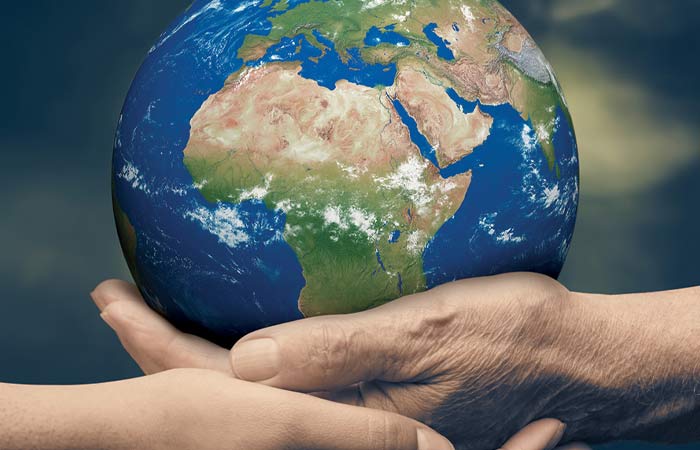
Choosing Earth, Choosing Us: Book Review of Choosing Earth
By Robin Beck
Everything, Everywhere, All at Once: Movie Review
By Jeff Sullivan
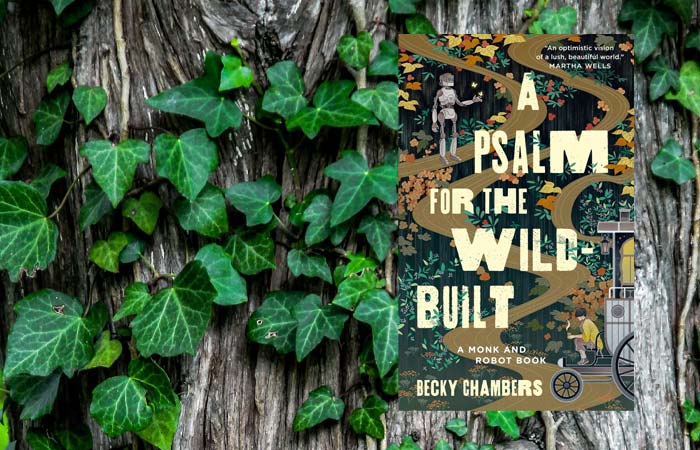
Monk and Robot: Book Review of A Psalm for the Wild-Built
By Robin Beck