
You see, all too many meditators look at classic mindfulness only as a way to maintain focus in an ADHD world. Or to calm down when the news or traffic raises your hackles. It's thought of as therapy or as a first step to quiet down racial stress or trauma triggers. But these days, it's rarely looked at as an actual graduated path to profound insight and liberation from the bonds of false and limited view s that cause suffering and perpetuation of a life ruled by ignorance and delusion.
So when I cracked open this book and began to read exchange after exchange between this unlikely upasika (seeker) and her teacher, I was dumbfounded by what I found. Each concise and earnest letter describes her journey into higher and higher states of absorption. She articulates her conclusions and requests clarification. How far has she gotten on the path? Is her energetic experience an indication of a significant spiritual insight or not? Should she push ahead or loosen up? I?d never found anything remotely like this collection of correspondence. I had stumbled on a precious gem, right in the middle of the bustling second floor of the Colombo airport last year, as I waited for my flight back to the US.
In Asia, you can still walk into a bookstore in any train station or airport and find works by great spiritual masters like Vivekananda and Yogananda, Ramakrishna and Ramana Maharshi, and classical texts like the Buddha?s Suttas or the Bhagavad Gita. In Colombo, you also find paperbacks from the Buddhist Publication Society (BPS) in Sri Lanka, perhaps the greatest English language Theravadan publishing house, founded by the German monk Nyanaponika Thera. BPS has been responsible for keeping the classic translations and commentaries on the Pali Canon in print, providing scriptural sustenance for seekers and scholars alike.
As I was perusing the books, looking for a way to spend my last local rupees, I scanned over authors and titles familiar to me from my time at Buddhist Viharas in India in 1983. I found classics by Nyanaponika Thera (1901 – 1994), Bhikkhu Bodhi (b.1944), a warm and happy Brooklyn born Jew who ordained in 1967 while still a graduate student in the US, and by Soma Thera (1898 – 1960), a Sinhalese Catholic who became a Buddhist as a teen, studied in Japan, translated Buddhist texts from Chinese to English and received higher ordination as a monk in Burma. These monastics were my companions in my early years of practice. Their works taught me all about the wheel of cyclic existence and the Buddha's life from privileged prince to extreme ascetic to Middle Way realizer, to effusive orator and community builder.
Those thin paperbacks revealed the definitions and cultivation of righteousness, wisdom, purity, and humility, and the jhanas (or states of meditative insight). Through them, I learned Pali words like metta (loving kindness), mitra (spiritual friendliness), and mudita (sympathetic joy). I contemplated the concept of ehipassiko (open- handedness or come and see for yourself); the gesture of a proffered palm, extended, giving wisdom teachings freely, and asking nothing in return. I learned about the Buddha?s injunctions to be a lamp on one?s own way, exhorting us to discern and experiment for ourselves, to not take doctrine on faith but rather through observation and analysis. These texts also imbued in me the urgency to take the possibility of enlightenment or liberation from false and wrong views as a real and practical aspiration and goal to strive for, in this life, in this birth.
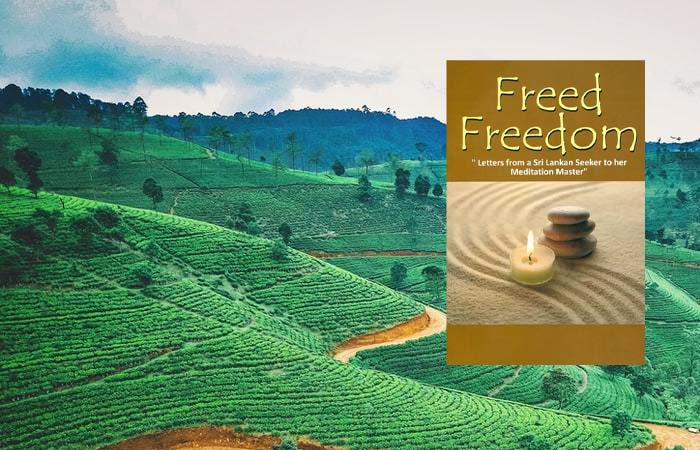
So, when I opened Freed Freedom: Letters from a Sri Lankan Seeker to Her Meditation Master, I found an account that spoke to me from many sides: an independent woman practitioner engaging seriously on her own with no social supports; clear analysis and advice from one who has studied as well as experienced; dedication, discipline and discernible fruits from meditation well practiced; and a door to the deeper and deeper wisdom that is possible if we follow our curiosity without limits.
The introduction to Freed Freedom explains to us that The Maha Satipatthana Sutta (the Buddha?s discourse on mindfulness) tells us two things. It assures us that there is a path of purification and the ending of grief, and a way to realize freedom or Nibbana. It guarantees that “if anyone were to develop them at most for seven years or least for seven days”[i] one could gain real fruits of higher knowledge. This book included correspondence over seven years with an unnamed author and a teacher, referred to only by his venerable title, not by an individual name. The master's letters are written by one of his attendants, communicating his responses
directly to the upasika or seeker. The book's Table of Contents is divided into these sections: Anapanasathi (mindfulness practice); Vipassana (Insight Knowledge); Sotapanna (Stream Enterer); Sakadagami (Once Returner); Anagami (Non Returner). Intriguing.
I started reading like a moth drawn to a flame. The letters start in May 1979 with precise instructions about the practice of following the breath. This back and forth correspondence continued, punctuated by references to periodic in-person visits. The master comments, guides, and refers to the Buddha?s injunction to assess her own experience; to test and determine for herself. Here?s an example of one of his more technical instructions from midway through her journey. (Note: brackets indicate my additions and comments; parentheses are from the original text.)
3rd November 1984
“What one has to do is purify the mind gradually allowing Panna [wisdom] to grow” (refer to Seven Stages of Purification).
Saddha [trust or faith] is of varying degrees, but it is not mere blind faith. It is confidence, developing together with understanding (i.e. Panna). For one develops Saddha in the Buddha, Dhamma [teachings about discernment into the nature of reality, also defined as Buddhist doctrine], and Sangha [community of practitioners] only when he [she in this case!] really understands the qualities they represent. For an example, when one realizes ?Annicca? [impermanence] directly through his [her] own bodily and mental processes, his [her] Saddha on the aspect of the Dhamma would be established firmly, thus in the Buddha and Sangha as well.
When developed highly, Saddha becomes a force (Bala) and a controlling faculty (Indriya).
How long have you been sitting in meditation at a time? Usually sitting down should not exceed one and a half hours. This period should be determined according to one's physical conditions too.
Wishing you every success in this very life.”[ii]
Who was he? As far as I can discern, the meditation master is Mitirigala Nissarana Vanaya. W ho is he responding to? Revealed in the afterward is a memoriam to Miriam de Saram (b. 1908 d. 1999), the highly spirited seeker who was a lifelong member of the Protestant Church of England. Born in 1908, Miriam married a lawyer, mothered four children whom she raised on her own, and was a member of the Ceylon cultural elite. She had a highly discriminating and analytical intellect, was known to like to drive quite fast, was a classically trained Kandyan and South Indian dancer, and was accustomed to following her own will, interests, and passions regardless of
social convention. She was, in many regards, a woman after my own heart.
Miriam's interest in penetrating into the nature of reality began at the ripe young age of 71. It was a passion that took her very far in this latter stage of her life.
In some sense, the details of the two letter writers are less relevant than the meditative journey and the substance discussed. The salient ingredient for me was that this correspondence took place during the same years I was seeking and meditating; meaning, it occurred not in the distant past, but close enough to touch. And it followed real experiences and guidance that vibrate with a ring of authenticity. For those curious to hear a little of her journey, I have pulled a few excerpts; though to really appreciate the immediacy and inquiry of this unlikely meditator, I can only encourage you to read the correspondence from cover to cover and engage in the same ardent practice yourself.
8th March 1986
“Now after an experience last night I think I was wrong in my judgement (then expressed). This new experience I think may be nearer the Pahala condition [fruits]. Its signal characteristic were (1) Disappearance of all vibrations, (2) heart beats, (3) breathing (the breath seemed to travel inwards in my chest and gradually disappeared). So there was nothing existent except the awareness of a wonderful peace and rest.” [iii] [M.S.]
8th April 1986
…Though the description of your insight build- up for a higher path is convincing, the Venerable Thero recommends these tests so that you could verify for yourself whether the pull towards the highest has had any significant result.” [iv] [Ven. N.T.]
12th April 1986
“I felt every atom of my mind and body had changed into an intangible substance which held within itself unknown heights of power (from the electric force), bliss and Joy (gained in Samapatti) [one of four attainments]. Till now, they have been separate. But now they are united in some unknown alloy. It is only in stillness that this can be obtained. Power and strength, peace and joy can be found in stillness.” [v] [M.S.]
24th April 1986
“in this instance of a continuous awareness of nothing … you were confronted with Nibbana as the object which is visankhara ? the very absence of sankharas [the karmic momentum that leads to dependent origination]. He too wonders whether this clearer vision of Nibanna is the result of your attaining the Fruit of the Second Path, but he re- iterates that the onus of proof is on you. And with this, I shall put down his instructions in general on how to proceed” [vi] [Ven. N.T.]
I invite and encourage you to read this book following the questions of a novice meditator and leading all the way to the experiences of a non-returner. I wish for you, as you read, that the sublime quality of mudita or sympathetic joy awakens in your heart. May you experience the immediacy of Miriam?s journey and the penetrating discernment of Venerable Nayaka Thero?s responses. May the awakening of joy yield the fruit of renewed inspiration. And may you re-commit to your own practice without delay, in faith and conviction that the riches of insight, purification, and release await those who ardently and diligently apply themselves to the path of freedom.
[i]Freed Freedom: Letters from a Sri Lankan Seeker to her Meditation Master. (Dehiwala, Sri Lanka: Buddhist Cultural Centre): 10.[ii]Ibid, 61- 62.
[iii]Ibid, 104.
[iv]Ibid, 115.
[v]Ibid, 121.
[vi]Ibid, 127.
Interviews

Artificial Intelligence and the Evolution of Consciousness
Interview with Steve McIntosh
Presence Cannot Be Simulated
Interview with Charles Eisenstein
Beyond the Creative Glass Ceiling
Interview with E. J. Gold and Claude Needham
“I Feel Responsible”: The Challenges of Bringing AI to Ethiopia
Interview with Mekdes Asefa
AI and the Future of Our Classrooms
Interview with Amy EdelsteinBook Reviews

A Summary of the Fetzer Institute’s Sharing Spiritual Heritage Report: A review by Ariela Cohen and Robin Beck
By Ariela Cohen

Choosing Earth, Choosing Us: Book Review of Choosing Earth
By Robin Beck

Everything, Everywhere, All at Once: Movie Review
By Jeff Sullivan
Monk and Robot: Book Review of A Psalm for the Wild-Built
By Robin Beck