
The Artist of
POSSIBILITY
articles
Image
November 15, 2023

An Introduction to Yoga Nidra

Interview with Dharma Mittra
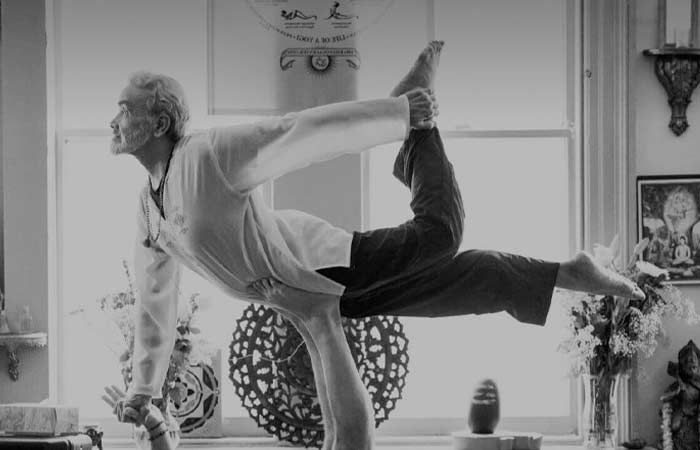
Sri Dharma Mittra first encountered yoga as a teenager before meeting his guru in 1964 and beginning his training in earnest. Sri Dharma founded one of the early independent schools of yoga in New York City in 1975 and has taught hundreds of thousands of students the world over in the years since. Sri Dharma is the model and creator of the Master Yoga Chart of 908 Postures, the author of “ASANAS: 608 Yoga Poses,” “Yoga Wisdom” and “The LOAY Teachers’ Manual,” and has been featured in a variety of videos produced by Pranamaya, Alo Moves and Yoga Journal among others, and the Yoga Journal book “Yoga” was based on his famous Master Chart. Sri Dharma continues to disseminate the complete traditional science of yoga through daily classes, workshops and his “Life of a Yogi” Teacher Trainings at the Dharma Yoga New York Center and around the world. For more information on all things Dharma Yoga, visit: dharmayogacenter.com

I first met Dharma Mittra in the early 1980s in New York City. I had no interest in spirituality at the time but would regularly walk past the corner of 14th Street and 6th Avenue, where, if I looked up above the sidewalk level, I’d see a glowing neon sign that flashed “Yoga” above the busy noisy corner. One day, out of curiosity, I walked up the two flights of stairs to take a peek and to see what this center was, and was met at the door by a sweet humble man with a funny sense of humor–Dharma–who invited me into the studio. The place was spotless, with a blazing thick red carpet that was impeccably clean. He showed me around the empty studio, which had all kinds of strange symbols and wall hangings, and I had an immediate good feeling about the place. Dharma gave me a coupon for a yoga class – $3 and told me I was welcome. I thanked him and left and came back the next day. I started taking classes daily at the center and immediately began to experience expanded states of consciousness including transdimensional states that I never knew existed before. This was the beginning of a decades long relationship with Dharma as a student and a friend. Dharma has been teaching Hatha Yoga for over 50 years. Since the beginning he always reserved a significant time at the end of the class for yoga nidra, or the “yogic sleep” which he would say was very important. Since Dharma has been teaching yoga nidra for decades, and is a master of the practice, I thought he would be a great resource for better understanding the purpose and potential of this valuable tool for self-knowledge.

~

KD Meyers: You and I have a long history together and right from the beginning, you were always doing yoga nidra, or as you called it yogic sleep. I wanted to interview you because of your many years of experience and expertise with yoga nidra.

I have a few simple questions for you because, of course, the answers to simple questions contain everything we need to know. So to start with, can you tell us how you found the practice of yoga nidra?

Dharma Mittra: I met my guru in 1964 and was introduced to yoga nidra because he used a short version of it with us after we completed practicing asanas. He did this to restore the body and remove fatigue. It wasn’t until maybe 1998 or 2000 that I invited someone to come to my center and give a workshop on yoga nidra. That person led hour-long yoga nidra sessions. I was very curious about that and I attended his yoga nidra workshop. I was shocked by how powerfully the sessions affected me. That experience inspired me to start leading my own yoga nidra classes independent of asana practice. My intention in doing this was to support the healing and recovery of the body. That is how I initially discovered yoga nidra and the fact that it could be practiced on its own.

KD Meyers: Can you tell us exactly what yoga nidra is? How would you describe, define, and explain it?

Dharma Mittra: Well I can use a technological analogy to help us understand it. If we want to restore our computer to its original factory setting, we have to close all the applications that are draining energy from the utility disk. Yoga nidra can be seen as a similar process which gradually and consciously puts the body into a state of deep restful sleep. A sleep that is almost like sleeping while remaining in action. The body relaxes first and the mind follows by slowing down and relaxing because there is less activity going on to process. In yoga nidra we remain alert all the time, and as we relax and lose a little bit of our consciousness we are taken to different levels of awareness and discover how our minds operate on hundreds of levels simultaneously. Resting at these deeper levels triggers restoration and healing, as well as the expansion of consciousness. This is the process of yoga nidra; we cautiously put the body into a state of total relaxation where the mind is almost completely at rest, and from there everything else unfolds naturally.

KD Meyers: Can you explain the difference between yoga nidra and meditation?

Dharma Mittra: The difference is that in most cases, yoga nidra is done for the restoration of the body and gives us healing benefits similar to what we get from deep sleep. Almost everyone is concerned about their well being and so these healing benefits are universally attractive. Not everyone is concerned with remaining awake all the time, but that doesn’t matter because even if we fall asleep in yoga nidra and lose conscious awareness, we still gain the benefits of deep sleep because that happens automatically. A big difference with meditation is that in that practice we have to hold our posture and therefore part of our consciousness must be used to keep the body in its seated position. This will keep us alert all the time so we don't fall asleep. This serves us in meditation because the goal is to dive deeply into divine perception. The upright posture of the body helps. The spine and neck and head are erect and the body is still. This gives us the ability to go into deeper layers of consciousness, and level by level we enter more and more subtle depths.

KD Meyers: How do we expand consciousness with yoga nidra?

Dharma Mittra: You expand your inner awareness by observing mental activities. First, you witness your attention by watching as it goes here and there. Observing everything arising and passing away creates a sense of time. You can go deeper by asking, where is this witness? It can help to use your imagination and imagine what it would be like to have no face. The witness has no body, no face and no thoughts. By letting go of these you move deeper into divine perception. It never ends, you keep going and that is what it means to expand your inner awareness. If you continue letting go you will discover a sense that allows you to feel what is true. Using this higher sense of perception you can see directly the truth behind the things you believe to be true. This is how the mind walks toward self-realization, which leads to the direct recognition that we are the actionless witness. Beyond the actionless witness there is still more because in order to be a witness you need senses of perception and that points to consciousness itself. Many scriptures say that we are consciousness itself. But what is consciousness itself? It is the ability to be conscious without anything to be conscious of. If you go deeply enough, you can disappear during yoga nidra because there is nothing to be conscious of.

KD Meyers: So Dharma, what are some of the techniques involved in yoga nidra? What is the basic description of how you do it?

Dharma Mittra: Start in a beautiful comfortable place. If you are at home, maybe in your bed, with pillows under your neck, arms, knees, and heels. You have to be totally comfortable. Don't put anything heavy on the tips of your toes. I usually allow there to be some light because that keeps me alert, but you have to be comfortable, and you also must have intense enthusiasm for whatever brings you to do yoga nidra– whether it be for healing or for the expansion of divine perception.

Yoga nidra always begins by relaxing the body. I usually begin by relaxing the lower body first. I explain to students that our body is made of cells and cells are beings. The glands and the organs are groups of cells and more intelligent. To act the way they do, glands and organs must have a connection with higher beings. We are the employer, and all the cells, organs and glands are our employees. It is important to make your employees comfortable. As the employer, you need to be kind to them. When you relax your big toe first, you are at the same time making contact with the cells, telling them you love them and asking them to relax. You explain that if you suffer they will suffer along with you. If there is a cancer cell among them, you can ask them to let you recover. Encourage them to relax and be happy.

At the same time that you are communicating with your body, you can connect with different help from outside. There are celestial doctors with celestial medicine, and they are waiting for us to ask them for support. So all this helps shape your mental attitude as you bring your attention to your big toe. You go through the toes first, placing your attention on each one in turn. Then you move to the foot, the upper part of the foot, the sole, the heel, the ankle, and then the knee, and thigh, and the whole leg. After that you move your attention to the other side and repeat the movements from the toes to the whole leg. Finally you move to your waist and the lower body is done. You're still conscious of your lower body, but you’re not using it anymore. It is at rest. It’s like if someone is about to have an operation and you put them under anesthesia. Everything is comfortable and at rest so the doctors can do their work. Once the lower body is done you move your attention to your left thumb, and then each finger one by one, then the wrist, then the forearm, the elbow, the upper arm, the shoulder, the armpit, and then your left arm is done. Again, think about each part of the body as an application on your computer that you have closed for a while. Once the left arm is complete, you relax the right arm in the same way. After that you move to the back, then the epidermis, the rib cage, the neck, and then you move to the skull, the forehead, the eyebrows, the cheeks, the nose, the lips, the teeth. When the whole body is relaxed you can bring your attention to a light at the top of the head. You can visualize it like a bright full moon, or like the sun. And you focus there for 5 or 10 minutes. Remain receptive, don't move, and stay with the light.

KD Meyers: How do you keep from falling asleep or becoming distracted when you practice yoga nidra?

Dharma Mittra: You have to find some way to stay awake and undistracted. If you need to have a bell ring every minute to stay awake, you do that. Before you start your practice be sure you have lots of rest so you won't need to sleep. It’s also best not to have food in your stomach. For beginners it’s almost impossible to stay undistracted and awake unless you eat a light diet, start on an empty stomach, and make sure you have lots of sleep beforehand. There is one other thing that is very important. You must be very serious about the practice. If you are serious about yoga nidra and it is important enough to you, you'll never fall asleep. I believe yoga nidra is the sleep of the future. I don’t sleep for many hours, but I do four or five yoga nidra sessions every day, one after the other. Every yoga nidra session is equivalent to 90 minutes of sleep. I might only fall into unconsciousness for maybe half an hour. This is the best rest for people. It is the sleep of the future.

KD Meyers: That is all the questions I have, but are there any final words you'd like to offer?

Dharma Mittra: Sharing this with others is very important. It is the highest form of charity, because If you share this with someone, they will become free from the need for medicine. I’m 85 years old. I don't use any medications. I go through life peacefully and happily because of my yoga nidra practice. Every time something goes wrong, I turn to yoga nidra. I encourage people to use the practice and share it with others. That's what I will do for the rest of my days. And I never stop learning more because yoga nidra keeps going deeper and deeper and deeper.

KD Meyers: Thank you so much Dharma for sharing your wisdom around yoga nidra. Namaste.

Interviews

Book Reviews

Essays

Book Excerpts

Featured Artists