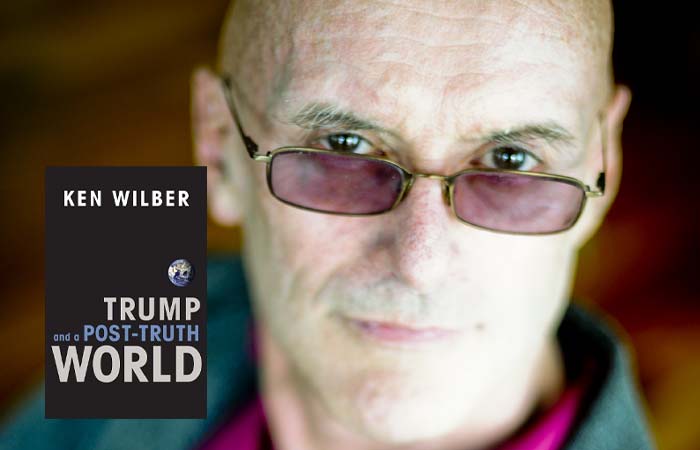

Ken Wilber: I want to start by saying something about what we’ve learned from developmental psychology. The ideas and attitudes that shape our culture don’t just appear out of nowhere; they grow and develop through predictable stages according to recognizable patterns of evolution. And, if we look at the different developmental schools that characterize those stages, there's an enormous amount of agreement as to what those stages are.
My book, Integral Psychology, includes an analysis of over a hundred developmental models from all over the world. Many of the models have identified a different number of stages, some recognize more, some fewer, but despite the differences they all chart a remarkably similar progression. Generally, you find six to eight major stages of development, but I think the best model for most purposes includes just four.
The first stage of development is called egocentric, which is a very selfish and narcissistic stage of growth. It tends to be exhibited in very young children before they’ve learned to empathize with another person’s experience. As they continue to grow, they move into what we call the ethnocentric stage of development and now their sphere of concern has expanded to include caring for a group of people that they identify with; a family, or tribe. So the ethnocentric stage represents an expansion of their identity to include the people immediately surrounding them.
Ethnocentricity has a negative connotation, because it often leads to an “us versus them” mentality. At this stage, we are drawn to our group and other groups tend to be looked upon negatively. This stage is an expansion in our ability to extend love, care and concern to now include our group, but at this stage it’s very difficult for our group to get along with other groups. In its negative forms, this stage can be racist, sexist, homophobic, transphobic, and all kinds of other phobics.
The next expansion is from ethnocentric to world-centric. At this stage, we identify not just with our group, but with all groups. And so we start to move away from the ethnocentric “us versus them” mentality. We now start to believe that all people should be treated fairly regardless of race, color, sex, creed or anything else. This world-centric stage of development is a fairly recent one in our overall evolution.
As an example, it was at the world-centric stage of development that the institution of slavery began to be unacceptable. At ethnocentric stages of development, slavery is acceptable, as long as the slaves are not “us”. It is interesting to note that throughout human history slavery was widely practiced, but then over about a hundred year period from around 1775 to 1875 every major developed nation on Earth abolished at least the legally recognized institution of slavery.
That's only about 300 years ago. Up until that point, slavery was alive and well and more or less accepted. Then suddenly, at least in an evolutionary time frame, people started to recognize that one person owning another person was wrong. It became morally repugnant and terrible, and people generally felt that the institution had to come to an end. In the United States, a million people died in a civil war in part to end slavery only a few hundred years ago.
The advent of the world-centric stage of development brought a new sense of morality, a new sense of what is right and wrong, and a new understanding of what is true. But that stage of development doesn’t just come all at once; it develops in substages, and understanding these world-centric substages will help us understand what is happening in our culture today.
The first substage of world-centric development is called modernity. It was born out of the Western Enlightenment and the age of reason. Once it emerged, the cultural attitudes and beliefs of modernity replaced those of the Middle Ages that had come before. Science and its preference for rational thinking replaced the previous magic and mythic beliefs of the medieval church.
There's an apocryphal image of Jefferson sitting in the White House, holding the Bible and a pair of silver scissors. He's fiercely cutting out all of the mythic stories from the Bible because he wants to boil it down to include just the pure, rational moral statements. It was actually published and called the Jefferson Bible.
But remember that evolution takes time. Even Thomas Jefferson, one of the architects of the modern era, still owned slaves. He could recognize that it was morally repugnant, but he still owned them.
The advent of modernism was a huge change that introduced rationality and formal operational cognition as a dominant force in culture. And, within just a few hundred years, all of the modern sciences were born. This was a big, big change. And it brought with it the first stage of the modern era. Soon, most people being born were not born into the egocentric or ethnocentric stage, they were born into the first stage of world-centric development and so almost nobody in the modern world thinks slavery as an institution is a good idea anymore.
Modernity became the leading edge of culture. There were still people at the ethnocentric level and even some at the egocentric level, but the culture as a whole was moving toward modernity, and those that were already there were leading the way. They were instituting their belief in universal truths and the value of freedom and dignity for all people. Again, we have to remember that this takes time, and in many ways modernity is still spreading.
In a general sense, however, human beings have been moving beyond the “us versus them” attitudes of the past for a few hundred years, and the ideal of universal human rights has in many ways taken hold. That ideal ultimately means that everyone has rights and must have access to the fruits of society. Democracy arose because it believed that all men should have the right to govern themselves (while not forgetting originally it was just men, and then it was extended to all black men and finally to all women).
Over the past half century or so, a later stage of modernism emerged commonly known as postmodernism, and with it came a new set of values. In postmodernism, a new value for diversity emerges that is a bit at odds with the quest for universality that characterized early modernism. This is when multiculturalism becomes important to people, but you can see this as a further development of the modernist ideal for universal human rights. First, there is an effort to universalize everything and create global systems, and then there is a movement to want to preserve and honor the diversity on the planet. This step is a move from the ideal of universality to the ideal of inclusivity.
So much of the divisiveness and polarization in our society is being caused because the inclusivity of late postmodernism is at war with the universality of early modernism. And if you look at the history of cultural development, it is common that as new stages emerge they tend to get into fights with the previous stages.
When science first emerged it started to battle against the mythic ethnocentric structures of the religious world of the Middle Ages, and that's where we got the science-versus-religion battles. And so now, as this value system of inclusivity emerges out of the universality of modernism, it calls itself “postmodernism” because it is trying to go beyond what it sees as the limits of the strict and rigid universal systems that tend to only allow for one definition of truth.
The problem with universality is that it can’t accommodate the diversity of truths that exist. It only allows for one truth, and so if you don’t agree you can only be wrong or confused. Postmodernist thinkers like Foucault or Derrida started to argue that all cultures have partial truths and they all have to be included.
The postmodern stage that exists today at the progressive edge of culture is a champion for inclusivity and multiculturalism. It is good at differentiating and appreciating all of the diversity represented by various peoples and cultures, but it is not as good at integrating them into some kind of an inclusive whole that can work together. The ability to not only recognize diversity but actually harmonize it into a functional whole does not emerge until the next level of development beyond postmodernism.
Multiculturalism creates diversity, but it doesn’t create coherence. It doesn’t bind that diversity together again, and so it produces polarization. And this is also typical of the overarching pattern of evolution. If we look at how things evolve, whether they be cultures, or species or organisms, we find that the process of evolution first diversifies and then re-integrates. A single cell, a zygote, first starts to divide, and differentiate into two cells, then four cells, eight cells, and so on. Differentiation is occurring, but at the same time processes of integration are bringing those separate cells back together until a whole organism grows out of this process of differentiation and integration.
The great thing about rationality was that it integrated everything into universals. And the great thing about postmodernism is that it differentiates and recognizes diversity. But neither of these stages is capable of reintegrating that diversity. For that, we will need a stage of development called Integral.
The psychologist Clare Graves, who founded the emergent cyclical theory of human development, called the Integral stage of development a “cataclysmic leap forward” because at that stage we can integrate all of the diversity into a coherent whole again. The Integral stage of development reaches down and integrates all of the previous stages, and that is very, very important for where we are right now. At this moment only about 5% of the population worldwide is at the Integral stage. So It is starting to emerge, but just starting.
The postmodern stage of development emerged in the sixties with the inclusivity movements of the Boomer generation. The Integral stage only started to emerge about 20 years ago, and we're looking towards its emergence to unify and integrate all of the diversity of the previous stages and put an end to the divisive polarization that we are experiencing now. The Integral stage actually reaches down and embraces all of the previous stages, and right now that means unifying modernity and postmodernity.
This ties in with the theme of The Nature of Truth and Reality because what distinguishes each new stage of development is that it sees a different truth and it has a different value structure. The egocentric stage values only its own perception of truth and “it’s all about me”; I'm the only one that really counts. It can’t empathize with the perspective of the other at all. A small child at this stage of development can’t imagine that someone else is seeing something different than they are. If you put a ball that is red on one side and green on the other between two children at this stage of development, they will each say that the other child is seeing the same color as them, even if they have been shown that the ball is two colors. A few years later, they will easily recognize that the other child is seeing the other color, and they have entered a new stage of development.
As the ability to see from another person’s perspective continues to grow, you eventually become able to see that everyone has a valid perspective. That capacity is what gives us the universal world-centric stages. But as we have moved into the postmodern stage of development, we still have the original universalist values of modernism now existing alongside the diversity values of postmodernism, and those two value systems don’t get along well at all.
At the postmodern stage, everybody has a partial truth and all truths must be valued as equally true. This view could also be called egalitarian. At this stage, you can't say that one culture is better than another, and this is what starts to cause trouble that results in culture wars. The modernist value system believes in free speech and individual rights. The postmodern value system believes in these things too, but it believes in social justice even more. It doesn’t fight for the rights of individuals as much as it does for the social justice of all groups of individuals. Postmodernists believe in free speech, but they don’t believe that the idea of free speech should include hate speech, even if the Supreme Court has ruled that it does. Unfortunately, the postmodern multiculturalists are often so committed to the value of multicultural diversity, and so certain they are right, that they don’t feel the need to even talk to the universalists of modernism.
The division and polarization between modernism and postmodernism is the main battleline right now, but of course there is still some ethnocentricity around. These ethnocentric structures include racism, sexism, misogyny, white supremacy, the KKK, Neo Nazis, etc. These things still exist, and they are very real problems that need to be addressed, but they don’t have that much institutional power. The biggest problem we face right now is the divide between the universalist ideals of modernism and the multicultural ideals of postmodernism. And I don't see anything on the horizon that is going to heal that divide except the emergence of the Integral stage of development.
The Integral stage can unite and integrate the previous two. It can bring the modern and the postmodern together, and historically when 10% of the population reaches a new stage there is a kind of tipping point. For instance, when the rational modern stage first emerged out of the medieval mythic stages, the tipping point happened at about 10% of the population. When the constitution of the United States was written, only about 10% of the population was actually in a position to fully understand the deeper implications and significance of what it represented.
The same thing happened with the emergence of postmodernism. In America, around 1959, the percentage of the population at the postmodern stage was about 3%, but by 1972 it had reached 10%, and suddenly the French postmodern philosopher Jacques Derrida became the most frequently quoted academic writer in America.
Right now we're seeing 5, 6 or maybe 7% of the population at that Integral stage of development, and as soon as it hits 10% we can expect to see the same kind of tipping point. Until then, the battle between modernism and postmodernism will continue to create polarization and division, but after that we will start to see a new coming together.
Interviews

From False Identity to Divine Truth
An interview with Sadhvi Bhagawati Saraswati
Living Transmission: The Full Spectrum of Vedantic Awakening
An interview with Acharya Shunya
Let Your Awakening Be a Force for Change
An interview with Jac O’Keeffe
Thinking the Impossible: New Myths for a Future Consciousness
An interview with Dr. Jeffrey Kripal
Mapping the Noosphere: Science, Mysticism, and the Geometry of Consciousness
An Interview with Shelli Renée JoyeBook Reviews

A Summary of the Fetzer Institute’s Sharing Spiritual Heritage Report: An review by Ariela Cohen and Robin Beck
By Ariela Cohen
Choosing Earth, Choosing Us: A book review of Choosing Earth
By Robin Beck
Monk and Robot: A book review
By Robin Beck
No Pallatives. No Promises: Radical acceptance as one woman's path to living with grief
By Amy Edelstein