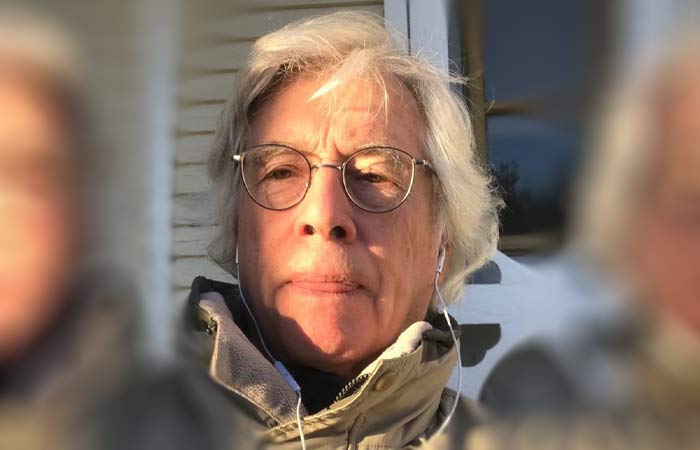

Jeff Carreira: Hello, Lawrence, I've been reading through your book, The Soul's Journey, and I read Awakening Kundalini some years ago. Our current issue is exploring the topic of Awakening Through the Body and I felt that your work with kundalini would be an important addition.
To give some personal context, I want to say that a great deal of my spiritual work was done in the tradition of Advaita Vedanta in the lineage of Ramana Maharshi. The work was a form of jnana yoga and the goal was to realize that you are pure conscious awareness so deeply that you can never doubt it. I was taught that spiritual experiences such as the energetic awakening of kundalini are potentially distracting and should be de-emphasised. As part of my journey, I experienced a powerful kundalini awakening that shot white light from the base of my spine through the top of my head. As a good student, I did my best to move on from that experience without getting distracted by its wonder. Years later, when the community I had lived in disbanded, that kundalini experience was one of the first things that came to my mind. I wanted to explore what had happened and that led me on a journey exploring various forms of energetic and movement based spiritual practices. It has become increasingly clear to me that our bodies are always involved in the process of awakening, even if we are not paying attention to that aspect of the process, and I would love to start by asking you to respond to that thought.
Lawrence Edwards: This is fabulous. Yes, awakening is an event that involves our whole being. Our cartesian understanding of ourselves teaches us to experience ourselves as if we are a mind that drags a body around with it, or a body that carries a mind. The inseparable and integral nature of mind and body was largely lost a long time ago.
But before we get too far it's important that we start with a definition of kundalini. Kundalini is the power of the infinite to know itself both as the infinite and as the finite, and it is not unique to the Yogic tradition. The name is unique. Kundalini is a Sanskrit name that has certain symbolic qualities to it, but on a more universal level we are talking about the quest to know the truth of who we are fully and completely, and to live that truth moment to moment. Kundalini is the innate power that allows the awakening process to unfold, and it is not bound by our ideas about the mind and the body being separate.
The idea that there is a mind separate from the body is born out of the mind and it has no influence over the universal life force energy of Shakti. For Shakti, there is no separation between mind and body. That separation was created as an idea in the mind and it needs to be dissolved. Shankaracharya himself – who was the originating root guru of Advaita Vedanta and considered to be an enlightened sage who taught Self inquiry as a supremely direct path to knowing who you are – had a spontaneous awakening of kundalini later in his life that totally changed his perspective. His famous book, The Soundarya Lahari is a hymn to kundalini that exclaims that everything, all enlightenment, all creativity, all insight, everything, is the unfolding of the power of kundalini. The paradigm of kundalini is all embracing, and the awakening of it was seen as the esoteric goal of the classic forms of yoga. Hatha yoga, mantra yoga, raja yoga, jnana yoga, etc. were all seen as leading to a place where the power of consciousness is awakened and radically transforms us. All yogic practices (sadhana) were seen as leading to the awakening of kundalini.
We practitioners get up each morning for years and years, and we have our routine set of practices. That routine may have been given to us by a guru so there's a certain surrender to it. We are surrendering to a practice that was given to us by a master. That discipline is a good thing for retraining the ego into surrender and obedience, but at the level of spiritual work there's a part of us that sees itself as busy doing something. There is a lot of ‘me’ in the picture and that can be problematic when kundalini awakens and we freak out because we thought the only thing happening was my ego mind telling me what to do and suddenly there are spontaneous things happening. We’re being flooded with blinding light, pain is arising throughout our body, and we aren’t doing any of it.
Those spontaneous occurrences are the innate wisdom of the infinite working through us. That energy shows us places in the body where we are blocked and need to open. Constraints in the body are impeding the flow of higher knowing and shutting down the unfolding of the divine through us. The power of kundalini is going to initiate a purification process that is not dictated by the mind. In fact, it is often in total conflict with the ideas of the mind, sometimes even in conflict with the spiritual tradition that brought us to awaken. I’ve been contacted by Zen monks who have had sudden awakenings that their teacher tried to stop because they didn’t understand that the enlightened state occurs in our whole body, and that means in all of our bodies – physical, subtle, causal, and supracausal. You don't just have a physical body, you have a continuum of bodies from the gross nature of physical matter to the most subtle, refined levels of consciousness. It is all part of a spectrum of consciousness and that energy makes up everything. All of the universe is that, so everything must participate in this full-bodied awakening. Nothing is left out. It's only the mind that sees in terms of either/or. The mind is comfortable with either/or distinctions. It likes to compare and contrast and spends a lot of time doing that and often gets caught in the process, meaning it gets identified with it. With Shakti kundalini all boundaries are gone. All of our ideas of separation disappear. We’re freed from all forms of limited identification.
Jeff Carreira: In my own path. I had many experiences of what in your book, The Soul's Journey, you refer to as the eternal witness, and what I often refer to as cosmic consciousness. Those are the experiences I gave the most significance to because they were the most ideologically aligned with the path I was on and the tradition I was working in. I love what you just said about the routine and the practice and the devotion to the teacher, all of which I experienced, including all of the benefits of those. There are benefits of discipleship, but at some point those benefits came to an end because I had to find my own way and take responsibility for my own path. After that I found myself becoming increasingly fascinated by kundalini, and wanting to explore beyond the jnana path of Self-knowledge, including the practices and philosophies of raja yoga.
Even as a jnana practitioner I engaged in physical disciplines, but mainly I saw them as a way to overcome the limitations of the body, not as working with the awakening powers of the body. I was trying to awaken to the causal truth of eternal witness and I was in a tradition, at least in the way I learned to interpret it, that saw the body as something that needed to be transcended. My more recent fascination with raja yoga stems from my recognition that the physical and energetic practices of this form of yoga are designed to help you awaken to the causal truth of the eternal witness and open a channel that allows the divine to flow through you into life. That moment to moment connection with the divine is what I have become increasingly dedicated to. It is clearly profound to know who you are beyond any possibility of doubt, but it is something else to also have the living flow of kundalini, of Shakti, infusing your life continuously. I would love to hear you speak about the potential of not just knowing who you are or realizing who you are, but of living those energies all the time.
Lawrence Edwards: Yes, because too often, the knowing of who we are is only cognitively based. It's a shift in our cognitive experience. If we do Self-inquiry practices and neti-neti practices, we peel away everything and end up in the pure space of awareness, but often it tends to be an abstracted experience. And what is important in the Kundalini tradition, and also in what the Buddha taught, was having a full unfolding of consciousness. Just because I have tapped into the awareness of Self, doesn't necessarily mean that I've realized the entire spectrum of that conscious power. We might experience the eternal being of Satcitananda, and the mind can take comfort in this higher cognitive space because it's similar to the mind in its limited form.
Often we feel that we can trust the cognitive part of the experience because that doesn't rattle our nervous system too much, but the rapturous feelings of love and the sense of merging with ecstasy in our bodies is much harder for the ordinary mind to deal with. The Buddha talked about boundless loving compassion, boundless wisdom, unshakable equanimity, and rapturous ecstacy. I can see why many traditions ask aspirants not to get overly involved with this because it really can be a distraction at the wrong time on a path, but to negate it entirely or denigrate it in any way is just turning against consciousness itself.
Jeff Carreira: I was reflecting, as you were speaking, on the fact that in my experiences of expanding to the outer limits of the universe and recognizing that I am THAT, there was also an experience of pure ecstasy. It feels like in the experience itself, all of the components that the Buddha spoke of are present. It is only afterward, when the personality returns to the forefront of awareness, that there is a conscious separating out of certain elements of the experience and focusing on others. I can also see that it was valuable to me at the time because it helped me attain greater depth in the realization I was focused on, but now it feels necessary to return to those places that were set aside and explore them. One of the avenues for this exploration that I have found recently is the practice of yoga nidra, which I had known about for years but never spent much time with. Part of that tradition involves setting a sankalpa, which is a very deep level of intention. I see an ordinary intention as something I want for myself, whereas a sankalpa is something my soul wants for me. I have recognized that my sankalpa can best be stated as, “I am fully embodied, awake and alive in all dimensions of being.” Once I discovered this, I could see that it has been the driving intention of my entire life, and that it is emerging in new ways and taking on new forms recently. My path always had a strong cognitive component that led to tremendous awakenings of consciousness. As I connect with the reality of the higher bodies of my being and other dimensions of reality, I want to be realized in all of it. I also recognize that all of these bodies and dimensions were always involved in my spiritual work even if I wasn’t aware of it. So I am rediscovering my spiritual history and seeing that there was a lot more going on than I was aware of at the time.
Lawrence Edwards: All paths have certain boundaries, and that is necessary for them to function because those boundaries focus and direct our energy. But the fact that the boundaries are necessary doesn't mean that what's on the other side of the boundary is bad or doesn’t exist. It's just that, for the intention of that path, it is helpful to be focused and directed. Later we often need to expand our path so that nothing is left out. We need to include the full body experience of rapturous love and ecstatic union so that we see how the threads of energy that make up the cosmos, our body, and every cell and atom, are all scintillating with rapturous ecstasy because that is the nature of existence. Our body yearns to participate in the process of awakening at this level. It's not just the mind that longs to realize itself, the body longs for that too. Everything is longing to awaken, to swim in the truth and be immersed in higher wisdom.
Jeff Carreira: I love what you're saying about the body longing for awakening too. A few years ago, I became involved with the indigenous tradition of Ancient Lomi Lomi and I worked with a wonderful teacher, Jody Mountain, who I will also interview for this issue. One of the central practices of Lomi Lomi is a form of massage in which the body is not being guided by the mind, but by the wisdom that arises spontaneously through physical contact. You allow your body to enter into direct communication with the body of the other, and follow the wisdom as it arises. I think in many ways you are teaching how to follow the wisdom of the body in the process of awakening. Is that a fair characterization?
Lawrence Edwards: Yes it is, and it dovetails with the cognitive practices we have spoken about because many of those cognitive practices are aimed at freeing us from the conditioned mind, the part that has been shaped by trauma, by past life events, and by many other things. If we want to listen to the wisdom of the body, we need to also be concerned with who's listening, and how clear they are. How clear is the consciousness that is tuning into the wisdom of the body? That's where all the work you've done on other levels of cognitive purification helps bring clear awareness to the process of listening to the body. That's so important, the two work together. When we've done the work that clears the unconscious habits of the conditioned mind, we can truly be present with the body, and listen to its wisdom without applying another conceptual framework that is equally conditioned by past influences.
Jeff Carreira: When I was working in the Lomi Lomi tradition, I saw how much I was conceptualizing my body, so that what I thought was a feeling was actually an interpretation of a feeling. It takes work to clear those habits of conceptualization so you can feel the body as it is. I did learn, at least to some extent, how to deconceptualize my physical experience so I was able to enter a place where I was responding directly to felt sensations, and that is very different from any level of conceptualization. Given what you're saying, I can see why it was valuable to set aside the kundalini experience I had so I could continue the work of cognitive purification. I feel like now, many years later, I have a clearer vantage point for the exploration of the body and its role in awakening.
How do you recommend that people approach awakening? What do you see as the most efficient and effective way to follow the path?
Lawrence Edwards: One of the hallmarks of kundalini awakening is that it unfolds in ways that are specific for the individual. Hatha yoga was developed out of kundalini yoga because all of its postures and practices were first observed as the spontaneous movements (or kriyas) of people going through the awakening process. Then the postures were systematized because it was discovered that, if you do them, they can initiate awakening. It is said that there are 84,000 asanas, and of those, 84 are central, but your body and your subtle body may only need four of those, or seven, or you might need three now and six months from now, and after that seven. It is the kundalini energy that has the wisdom to spontaneously prescribe the right postures at the right time. Hatha yoga was an initial practice aimed at helping to steady and clarify the body, to empower the body to participate in the process of awakening by opening us to be in flow with the dance of the divine. Hatha yoga, as well as other initial practices, help us attune to the wisdom that is already present.
In my teaching, I make use of the same kinds of practices, whether it's breath awareness, study, or many others, but mantra specifically is a very important component of the practices I offer because they are one of the key practices in the Kundalini tradition. There is a whole science to how wisdom consciousness is encoded in sound form, in the vibration of the energy of the mantra. The ancient sages didn't make up mantras. They heard them. Most of our language is mind-born. So we follow our thoughts, and they just keep us circling around in the maze of the mind. But the sounds of mantra arise from the infinite not the mind. Mantras are vehicles that our infinite Self projects into the domain of duality, so we can follow them back to the place they came from. If you start listening to the sound of the mantra and become more and more absorbed in it, your thoughts and concepts begin to dissolve, and you can feel that the mantra is energy running through your body, awakening insight within you.
Jeff Carreira: There is one question I have been curious to ask you since we both have devoted our lives to spirit. And I don't see anything else worth giving my energy to; my spiritual work is my life. It seems to me that in some ways, spiritual pursuit is more popular now than it ever has been, and at the same time, the pursuit of something we might call enlightenment has fallen out of favor. People are interested in many aspects of spirituality, but becoming a living vessel for the source of existence doesn’t seem to be what interests people. When I first entered the path in the 1980’s, it seemed like everyone wanted to be enlightened, but I don’t see that the same way today. Do you see the same thing? Is there a way to reinvigorate that spirit in today's world?
Lawrence Edwards: I think it's a great question because it helps to highlight what happens inside a practice when the ego mind co-opts it and looks at it in terms of the potential benefit. I think that's the phase we're in. Spirituality has become broader in terms of people's engagement with it, but people are using it for peak performance and to improve their lives. The sense is that practice is something we do for ourselves, for the benefits it offers. We do it because it stabilizes our moods, or it keeps us more focused, or it increases our creativity. The practice is done in service of the ego mind's agenda and the aspect of practice that is about selflessness and surrender freaks out the ego. Let's face it, that's not an easy sell. People don’t understand why they would want that. They are comfortable with spiritual practice within the narrow band of personal benefit, but not outside of that.
I also want to say that awakening happens on a vast scale, and once it is initiated, it introduces us to an evolutionary process that spans lifetimes. Awakening happens at a certain place along that long evolutionary path. Awakening tends to occur when we’re ripe, which usually means after we’ve pursued all kinds of other desires and we are done with that. Being ripe for awakening is important. That’s another reason why not everybody feels drawn to it. Not everybody is ripe for it. I saw countless people come to a powerful teacher like Muktananda and leave untouched while others left dramatically awakened. Not everyone is ready for that awakening.
Jeff Carreira: I've recently been opening to a new depth of understanding about the reality of the soul and the multi-lifetime journey of soul development. This has helped me see that we're all on a very long journey through countless lifetimes, and there is no one path for everyone in any given lifetime. The right path for you is the path that meets the needs of your soul at this moment on its larger journey, and ultimately no one can tell you what that is. We all need to learn to listen to the wisdom of our own soul. It has helped me relax around any ideas about there being a right way or a wrong way for everyone. I see that I need to listen to the needs of my soul so I can fulfill whatever function that larger journey requires right now. Our spiritual work is done in service of our soul's journey, and that's going to be unique to this particular moment in the context of the grand drama of awakening. I think what I hear as fundamental to what you teach is learning how to open to our own innate wisdom and be able to follow it effectively.
Lawrence Edwards: In the end, that's what the path boils down to. You've done all the practices, you've gained the disciplines, you've had the experiences, and the only thing left to do is to listen as deeply as you can to the wisdom of your own soul, which comes in cognitive forms, but it also comes in energetic forms, and it comes through the body. The awakening of kundalini is a process. It can be dramatic and spontaneous, or it can be gradual and spontaneous. There's different forms that it is going to take. But in whatever form, kundalini is the power of revelation and transformation that reveals the infinite to be our own true nature and it encompasses everything, all beings, all bodies; nothing is left out. The transformation is the transformation of this vehicle, this mind and body, so we can fully participate in the process of awakening. Nothing is left out of the awakening process of kundalini. That process embraces everything, including the inevitable pain of life. My body has had its bangs and dings, it’s been hospitalized numerous times and has had dozens of surgeries. And I've been in ecstasy in the midst of dying and in the midst of the most excruciating pain. I have seen that these can be simultaneously present. There is no either/or when we dial into the ultimate awareness. Everything is included. Consciousness draws us in and says, no, I embrace it all. I am fully present in all of it. Nothing is left out. Na Shivam Vidyate Kvachit. There is nothing that is not the consciousness of Shiva, or in the Kabbalah Ein Od Milvado, there is nothing that is not God.
Jeff Carreira: Thank you for sharing such a profound understanding of the awakening process.
Read Ascent To Union by Dr Lawrence Edwards.
Interviews

Growing into Oneness Together
Interview with Diane Musho Hamilton
The Evolutionary Potential of a Higher Being
Interview with Craig Hamilton
The Emergent Field of Interbeing
Interview with Elizabeth Debold
Awakening Together: Islands of Coherence in a Sea of Chaos
Interview with Peter Mitchell
Artificial Intelligence and the Evolution of Consciousness
Interview with Steve McIntoshBook Reviews

A Summary of the Fetzer Institute’s Sharing Spiritual Heritage Report: A review by Ariela Cohen and Robin Beck
By Ariela Cohen

Choosing Earth, Choosing Us: Book Review of Choosing Earth
By Robin Beck

Everything, Everywhere, All at Once: Movie Review
By Jeff Sullivan
Monk and Robot: Book Review of A Psalm for the Wild-Built
By Robin Beck