
The walls of the log cabin suddenly felt closer as I laid down in bed. My eyes began surveying the ceiling, a gaze that traced the lines of wood grains, once called limb and trunk, now severed and laid to rest, side by side, as though forming their own funeral pyre. Words came, silently: “Now we’re entombed together.” The voiceless words would be thoughts in most other moments, but these were merely a mask, molded by a momentary impression of my face. Behind the mask was a feeling, a feeling that had eyes whose gaze was turned to face backwards. It was a feeling that not only looked back but also listened, listened for the source of its own silent words. This was a feeling that sought its own origin – longed for it.
I continued laying there, eyes sauntering among the beams and walls, mind circling the place where this unsourced, self-seeking feeling seemed to have emerged. It left no tracks nor sign of the path by which it was able to penetrate the sealed walls of my private mental space. Thoughts continued seeping through the way water seeps through limestone bedrock, forming hidden hollows in which the water continues to drip. I imagined a pool formed at the bottom of a cave, giving each drop a voice and a vocabulary. As my body laid in its wooden tomb, enchanted. My mind’s eye remained fixed on this pool, one of modest diameter and impossible depth, contained inside a tomb of rock, illuminated only by the light of an imagination being slowly freed from constraint. Thoughts seemed to be compelled to merge with the pool, though I could not tell whether it was the pool drawing them in through a force of mental gravity, or if the thoughts were orienting and pushing themselves towards a self-imposed destiny.
I focused on one drop of thought, and as it fell into the pool I listened, “Waiting for sleep is to walk a strange path.” Then I listened as the drops formed into a stream.
How is it that two states, two worlds can be blended in the same mind and body? It is a strange sort of language spoken here, a creole—haphazard and expedient in its construction, broken bits of two tongues only faintly recognizable as one or the other, and yet there is a structure, there is transmission. Does sleep come for us or do we set off looking for this strange place? The transition between waking and sleeping is one in which our thoughts and feelings begin to be liberated from constraints—no longer are they condensed into objects possessed by our minds and hearts, no longer are they bound and constrained in the flesh of our bodies. In sleep they are free to assume any form they wish or leave altogether. In sleep, thoughts and feelings are no longer objects we possess, but spirits and entities that possess us. Thoughts and feelings are us and they are not us. In our waking state, we know this. In sleep, we forget. In the transitions, we are estranged. Strange as the path from waking to sleeping may be, even on an ordinary night, stranger still are the footprints left by a mind that wanders backwards along this path, trying to think about the always hidden source of thinking, like trying to bite your own teeth. Trying to feel for the source of feeling, like trying to touch your finger with its own tip. Trying to see the source of seeing, like trying to look yourself in the eyes without a mirror. How is it that we have come to believe a thought is something we produce from nowhere within, temporarily possess with invisible hands, and then lose to an unseen blackness “out there” beyond our reach. But if they are not mine, then whose? If they do not originate from inside me, then from where? And when they are released, where do they go? Where do they end, and I begin? What happens when sleep overtakes a mind and body turned inside out? The ordinary strangeness calls out to something more.
The stream fell silent. My imagined cave dissolved as I turned my head to face the table by the bed. With blurred sight, I made out the cover of the book I had placed atop some maps that I would need to guide tomorrow’s journey into the mountains beyond the cabin walls. The maps were two generations old but were clean and well-kept from a life spent rolled into cylinders. The paperback book that kept them from recoiling had rounded edges, its much shorter life spent in curious hands and tumbled in bags. The book’s cover and the exposed ends of the pages were sun-stained from moments, both long and frequent, spent in attempts to comprehend the many complex passages written by David Foster Wallace on the idea of infinity in mathematics, logic, and philosophy. As is the case of many of his works, the result was something produced by rumination, precisely the way a grazing animal takes the contents of one stomach’s digestion and consumes it again in yet another stomach—the output of one source being the input of another, yet still part of the same system, so that when seen from outside, the whole process seems to have strange sorts of twists and plurality in the otherwise singular and cyclical process. Such was also the manner that the sentences and paragraphs on the page were to be consumed—through repeated chewing and after a long process of digestion—so that the twisted loop between Wallace and the reader could be completed.
The design on the cover was apropos of this digestive strangeness. Between the author’s name at the top and the title of the book at the bottom was a symbol—a mobius strip, stylistically placed by the designer so that only three-quarters could be seen. The cut-off loop of one end was left to be completed by the mind of the viewer the way our mind might create a triangle from three dots. What was surely an unintentional effect, cutting off one part of the loop, had transformed the symbol for infinity into the sign of Aquarius—a fish formed by two arcs bending in opposite directions, one concave and the other convex. The lines that form the symbol of the fish share a common point of origin on one end, then they set apart their respective arcs but return for one last point of convergence which completes the body, and then finally depart and terminate to form the tail. The symbol of the fish formed by opposing arcs tells another story altogether, but there it was, hiding in plain sight, conceived in coincidence, and camouflaged as infinity.
The stare from the imagined cave returned as I looked at the cover. I started thinking about the cabin and the infinity beyond its walls, the one we think about when we look up, the one that inspired the thinkers that Wallace wrote about in his book. I thought about ideas like galaxies and blackholes and cosmic background radiation, and how the people who built the cabin never had these ideas because they didn't exist 100 years ago. If you could go back and ask one of the cabin builders about the universe, it would have been contained within the one and only galaxy we had thought to name. Afterall, the word “galaxy” is derived from the word for milk, which is also the defining characteristic for the name we chose to give to the class of animals that includes humans: mammals. The creamy pool seen in our night sky was as good a notion to define all of existence because what other galaxies were there? It wasn’t that there are many galaxies and ours was the milky one. It was that ours was milky and contained all there was and would be.
In the few decades after the trees were turned into the four walls and ceiling of the cabin, it was still the same sky with the same spill of milk into which Edwin Hubble would point his telescope and see that hidden among the constellations of stars and planets were fuzzy discs of light. We knew they were there before but had no real way of grasping what they were, where they were, or when. Hubble focused on one of these discs, whose light in aggregate was composed of countless suns that called out in a kind of visual echo. Maybe they spoke to Hubble, appeared to him as thoughts, the way the once-living trees in the cabin and imagined caves seemed to be speaking to me. If they did, then their words would make their way into countless other minds, and in aggregate would shine in a new kind of light. Hubble had found a way to measure distance and the maps of the sky would thereafter be redrawn, and our language would have to change. For the people building the cabin, they lived in the galaxy. For those who slept encased in the cabin walls after Hubble’s discovery, they lived in a galaxy. The galaxy became plural. In Wallace’s book, you discover that infinity is plural too.
Perhaps it is something kids still do now, but there was a time when children would play a kind of word game and appeal to infinity in a kind of competition for supremacy on a given matter. They would choose some quantity to qualify their position, which required of the opponent a necessary adjustment to their quantity to raise the invented and silly stakes. I like ice cream five hundred. Well, I like ice cream one thousand. I like it ten thousand. I like it ten million. The exponential arms race continues until the quantity is sufficiently large that one of the combatants invokes what they believe to be an unbeatable quantity, because they know the biggest number of all isn’t a number. I like ice cream infinity! That should settle it, but the solution is quite simple: infinity plus one. Typically, the initial invocation of infinity is shouted with joy, triumphant jubilation, and outstretched arms, precisely the way we believe Archimedes shouted “Eureka,” as though it were the first time the idea had been formed and the word spoken. The rebuttal, by contrast, is given with snark, crossed arms, and an upturned nose, as though no one had ever devised a more ingenious retort.
Of course, both children knew what was coming because they had seen this exchange in other venues. Really, they were baiting the other on the chance that they had yet to learn the rules. And of course, the children are also conveniently ignoring one of the defining features of infinity: that adding anything to infinity still leaves you with infinity. That is the whole point: infinity is not a quantity of points, but the entire universe of possible points, all of those that exist and those yet to be born. Infinity is the horizon that always remains one unfathomable step ahead, no matter our pace and no matter our place in the world. After Hubble’s discovery, it became necessary for us to return to the idea of the universe and revise its meaning, adding one to what we thought was infinity.
Humans have long recognized the fuzzy patch that we now know as the Andromeda galaxy. It wasn’t just seeing the galaxy that took us out of the center of the universe, it was seeing it as another galaxy. By those stars telling Hubble a story about who they were, when and where they lived, and where they were going, Hubble looked at the same disc of light but now saw something different. In having seen just one other galaxy as another galaxy, all the old ideas about cosmology and our place in the universe were transformed. New stories bring us into new worlds, and new worlds challenge us to speak with new words and think different thoughts.
These were the stories that had been passed down to me, stories of stars and collections of stars in galaxies and the expanse of space between them all. These were the thoughts that formed the mask I wore as I laid to rest among the still dead trees in the cabin. The trees that still seemed to glow with the light of their past and call out like the stars in Hubble’s new world. Perhaps it is the trees or the galaxies that are still speaking, telling us that the infinity sign (∞) is as good a symbol as any for the universe. Afterall, uni-verse, is a combination of the noun for “one,” and what we think is a verb meaning to turn back, bend, be changed, or transform. Literally translated, universe means “turned into one,” which we could also see as a turning back that is needed to be one, just like the mobius strip. Such was the universe of feelings that descended upon me from without, and the twisted loop of thoughts that emerged from within as I pulled the covers over my now slightly chilled body, and let my eyelids restore the rich black boundary between me and the visual world. All became quiet and still.
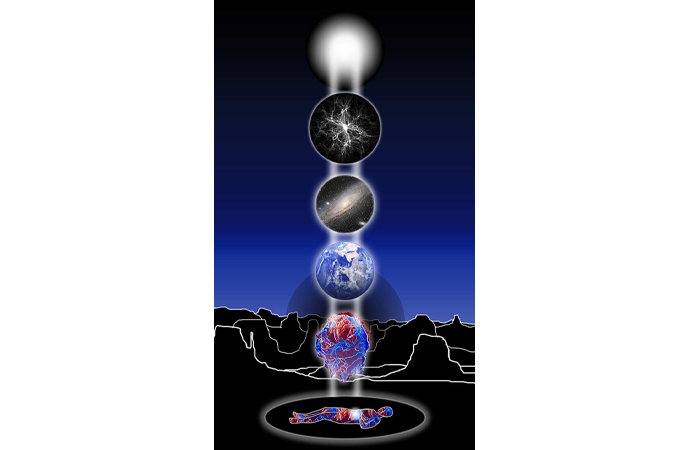
I was aware that I was looking at the back of my eyelids and could feel my presence in the cabin's one room. I could feel my body and the bed into which it was pressed. There was a slight chill on my face, and a faint, musty smell in the air. And then, in the stealthy manner in which ideas become dreamscapes, I found myself flying at high speed over a desert landscape, only I was still very much staring at the back of my eyes, positioned in the three-dimensional space above the floor, under a roof, and between the walls. I was simultaneously aware of two realities. In one reality I was a ball of plasma, purple in effect, but multi-spectral in my core. I was a substance too dense to be called light, but too insubstantial to be liquid. There were several other balls of plasma flying in formation with me. In the same manner I knew my dream body to be a ball of plasma, I knew these other flying plasma balls to be other bodies, other beings. Spires of red rock reached up from the desert floor and passed beneath us. And I began to break from the formation, rising.
In my physical body it started as a sensation. The feeling was warm and at the same time cold, like blushing in an ice bath. The sensation was several other contradictory things at once: it was fuzzy, indistinct, and hard to locate, but it also contained the precision of a needle, and was coming from a space above the top of my head and below the bottom of my feet. Between these two spaces there was a vibration, an electrical current that ran through my body lying there on the bed. This vibration also registered as the faintest ringing in my ears, and the smallest particles of white light began to appear in the black of my closed eyelids. And as I began to gain in elevation as a plasma dream body, this vibration began to intensify, the ringing became elevated in its pitch, and the white lights began to move with greater intensity, going from spots to little streaks.
My dream body rose into the upper atmosphere and as it did, I could feel something. The feeling carried the trace of a memory in which I had flown in this part of stratosphere before but encountered a barrier I lacked the energy to penetrate. The force of the barrier was like a magnet, although I cannot say whether it was a repelling force from the outside or a pulling force from below, or both. During this flight, I had more than enough energy to pass and in so doing, I also became stripped of the plasma form, and no other body that I was aware of had come to take its place. On the other side of this barrier, bodiless, I could see the outer bound of the blue planet come into view and begin receding with an increasingly rapid pace, until it was simply a dot among many others. Other planets would pass, stars began to clump and assemble, a pregnant spiral came into view.
As galaxies turned into clusters of galaxies, the vibration passing through my body intensified. The ringing in my ears moved into an even higher frequency. The black background between the streaking movements of light in my eyes was almost totally gone. Inside the body that was inside the cabin there was an increasingly uncomfortable tension building and its destiny proved to be a crescendo. Clusters of galaxies became clusters of clusters strung out as fibers. The vibration increased again. The galactic fibers formed a kind of primordial pattern that was projected onto a black sphere. The tension was unbearable. The pattern started to dissolve until there was only the surface of a blacker than black sphere. Then, just as the vibration reached the limit of what a human body could withstand, the outline of the sphere disappeared, and there was a black nothing for which even the word void is made too substantial, and in perfect synchrony with the dissolving of the sphere and my dreaming black body, there was a final vibratory burst of white light that shot through my physical body—total white, total black.
My eyelids raised and my consciousness was once again singular. I looked to the table by the bed and saw the symbol on the cover of the book staring back at me. At this sight, information streamed into my mind through what felt like an opening on the left side of my head the same way the loop of the infinity sign on the cover of the book had an opening on one end. It was a packet of fully formed ideas and images that came all at once and had to do with the nature of physical matter, space, and time, our place in the universe, psychic techniques we were only beginning to understand, and an explanation for what had just happened. While the external shape of this data package was clear and sharp, it was obvious that much of the detail inside remained encoded, and the means of its access and translation was not part of the initial transmission. It was not even clear that what required translation had the corresponding medium in which to be read. It felt almost like the difference between what we know as spoken language and body language, or some kind of creole that was both but neither, just like the state between waking and sleep.
A silent voice called out once again, offering a hint. It spoke of two paths. One where the paper maps under the book could be used to trace a path along the stream behind the cabin, the opening near the place where the sage grouse roosted and the stands of fir where the trees of the cabin had once grown, and their descendants now stood. A path whose source was the high places of the stone ancestor in the mountains that composed the northern horizon, where stories would need to be remembered and released from the bones of the sheep and pieces of rock scattered on the ground. This was the path of the ancestors, the path of the circle and cycles, and this is the path that would be encountered with the body as it stepped out of the cabin, out of the tomb and back into the world of the living. But there was another path, one to be walked with another kind of body, and it had to be followed too. This was the path of the spiral. This path meandered and twisted down into the strange southern valleys. Its course required other types of maps, filled with ancient symbols and esoteric landmarks, the contours of which charted an invisible terrain composed of feelings that wore masks made of strange thoughts. The only viable means of orientation in these lands was accomplished by sensing resonant vibrations and tracking feelings that blended familiarity and discovery.
The circle and spiral paths had dimensions both in and out of time. But what did that mean? What did any of this mean? What exactly had just happened? So much work was to be done and I would need help. But who to ask? It was then that I remembered the other balls of light and knew that was another clue. I only hope I will recognize them in their human forms. What stories we will dream? What will be remembered? And in the remembering, who will we be?
Interviews

Artificial Intelligence and the Evolution of Consciousness
Interview with Steve McIntosh
Presence Cannot Be Simulated
Interview with Charles Eisenstein
Beyond the Creative Glass Ceiling
Interview with E. J. Gold and Claude Needham
“I Feel Responsible”: The Challenges of Bringing AI to Ethiopia
Interview with Mekdes Asefa
AI and the Future of Our Classrooms
Interview with Amy EdelsteinBook Reviews

A Summary of the Fetzer Institute’s Sharing Spiritual Heritage Report: A review by Ariela Cohen and Robin Beck
By Ariela Cohen

Choosing Earth, Choosing Us: Book Review of Choosing Earth
By Robin Beck

Everything, Everywhere, All at Once: Movie Review
By Jeff Sullivan
Monk and Robot: Book Review of A Psalm for the Wild-Built
By Robin Beck