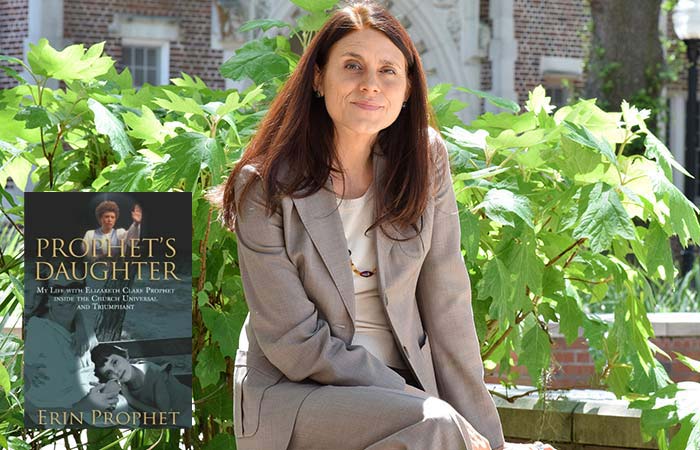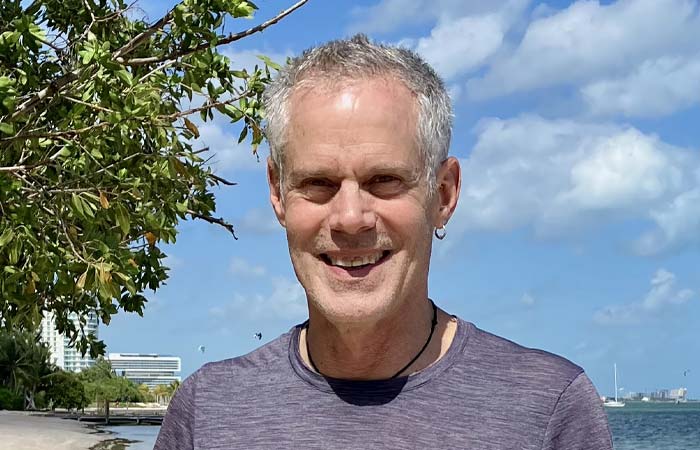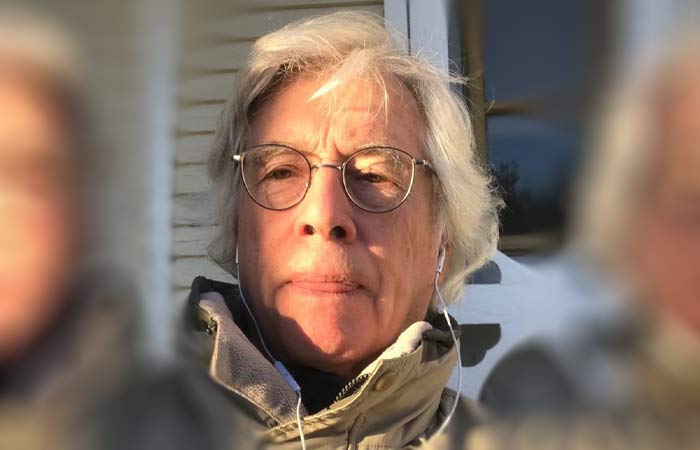

Jeff Carreira: Hello Erin, and thank you for speaking with me today. Your book Prophet’s Daughter is about the time you spent living in your parent’s spiritual community called The Church Universal and Triumphant. Can you begin by telling us a little about the church?
Erin Prophet: Sure. The group was actually started by my father in 1958 and its original name was the Summit Lighthouse. It had a loose organizational structure that was meant to include just a mailing list of people who did group meditations and things like that.
My father met my mother in 1961 and they were married in 1963 and my mother quickly became the co-leader of the group with my father. After he died in 1973, the group was refashioned into a church that promoted Eastern and Western spiritual ideas. A lot of it was built on Theosophy and the theosophical idea that there are divine beings or masters that are guiding the development of humanity.
Working with these ascended masters was really the primary focus of the church and its teachings. Self-help techniques and prayers were employed to promote spiritual development. The church reached a pinnacle of popularity in the late 1980s and early 1990s, but after my mother became ill and passed on in 2009, it began to dwindle. It does still exist, however, with a headquarters in Montana.
Jeff Carreira: I remember Elizabeth Clare Prophet for two reasons. One, because I had read a book called The Lost Years of Jesus that she wrote and loved it. And then, of course, for the whole story of her predicting the end of the world and building underground bunkers for the community to survive in. In my mind, as with many people at the time, that story became one of the quintessential stories of cultish behavior. Can you say a little about that part of the story?
Erin Prophet: One of the things I try to unpack in the book is how can a movement, which is focused on positivity and the union of Eastern and Western spiritual traditions, end up coming to worldwide attention through building bomb shelters in a remote location in Montana. What does this say about alternative spirituality in general? My parents were part of a more conservative strain of spirituality that was influenced by apocalyptic ideas that existed in Christianity and also in Theosophy.
Madame Blavatsky, the founder of Theosophy, talked quite a bit about planetary cataclysmic changes, and so there were a number of New Age groups that believed that big earthquakes would submerge large parts of the United States under water.
And there was a sense from the very beginning of our movement that we needed to have a place to retreat to and survive. If you follow my parents' work you find that interlaced among the positive spiritual affirmations; there was always a warning that people needed to change their ways, or bad things would happen.
I think our motive in having a retreat and moving to Montana was partly to have a place to meditate and get away from cities. And it was partly in anticipation of these big cataclysmic events. In the late eighties, my mother started giving dire warnings and prophecies and told her followers that they should leave the coastal areas of the United States. She recommended people build bomb shelters because she said it was very likely that there would be a nuclear war. There were other prophecies from the Bible, Edgar Casey, and other alternative sources that seemed to indicate that this was all going to somehow happen around the period of 1989 to 90. That's when we built the shelters.
Of course, after the fact the question that remained was, why did we do it and why did we spend so much money on it? That haunting question was one of the things that led me to start doubting, not the basic ideas, but the decision-making process that had emerged around a solitary leader who was believed to be the only one who could receive official communications from divine beings. I came to feel that there was something gravely wrong with a decision-making process that had allowed so much of the hard-earned money of our members to be wasted on this project. Those shelters had caused millions of dollars and almost bankrupted the group, and I saw this as a huge failure of our leadership. I was on the board of directors of the church at the time, so it initiated a deep period of questioning into how we should restructure our organizational model. Eventually, I realized that I wasn't going to be able to reform the church in the ways I had hoped and I decided the next best thing to do was to write about it and share my experience with others. In my book, I try to occupy a somewhat neutral space between being an insider and an outsider in the hope that people might learn from the experience.
Jeff Carreira: How many people were the bunkers built for?
Erin Prophet: We built a shelter that could house around 750 people and maybe, if needed, a few hundred more. There were also shelters built nearby that would fit several hundred. So we had room for about 2,500 people in shelters.
Jeff Carreira: All of this activity was instigated by prophecies from your mom and in the book you talk about how she was grooming you to divine prophecies. You even started to get information from higher sources. GIven the context, that's an incredible responsibility for a young woman to be holding. I'm curious how you see this now.
Erin Prophet: I've spent a lot of time thinking about what my mother really believed about the sources of her inspiration. Around my parents things seemed magical. They seemed to occupy a space of potentiality and many people believed they experienced healings and other miraculous events in their presence. I think people believed that they were angelic presences.
We believed that communication between humans and divine beings was possible and that we were all on our way to becoming divine beings. I hope to focus some of my future work on the process of channeling and revelation. My current working theory is that the channeling process works a lot like the creative process. An artist opens themselves and often the artwork will arrive in their mind as an image fully formed. Writers also talk about their characters taking over the story or not behaving the way the author expects. I think my parents had read a lot of esoteric and spiritual literature, and they put themselves in a mindset to receive revelation along those same lines. They didn't use the word channeling. They called them dictations and they were believed to be coming from God.
My mother would also give ordinary sermons in addition to the dictations. I would say that about 85% of what she offered was more ordinary motivational transformational stuff. When she did give a dictation that was more of a prophecy, she would always say that it was not what had to happen. It could be changed. Our whole belief system was based on the idea that if you alter your behavior, say enough prayers or decrees for instance, you could change the outcome. In a sense, you could say the prophecies offered their own kind of motivation. Once I started to train to give them I felt special for having been singled out for that role, but to be honest, it was not something I really wanted. I really wanted to leave and to go out and have some kind of job or career on my own so that I would have something to bring back to the community.
I was just 17 years old when I started being trained to take dictations. I had started college at age 15 and I took a break from college to begin the training. Later I went back and got my degree in journalism, and the day after my last final we were on the road to Montana. So I never really had a chance to live as an adult in the world until I left the church in 1993 after the whole shelter episode. I don't complain about the fact that I was roped into this because I did willingly participate and I thought I was helping and maybe even saving the church. I thought that the revelations that did come to me were designed to help us move forward.
The dates for the cataclysmic prophesied events came and went and nothing happened. Where do we go from here? We had a school and programs for alternative healing. We had planned to hold alternative medicine retreats. There was a hot spring spa and many other good things that we were planning to do on that land in Montana, but that all ended due to the building of the shelters.
We used most of the money that had been raised to build a school, a church and everything else. The shelter derailed all of our plans. And I felt that some of it had to do with the fact that the organizational structure was largely dependent on only my mother’s personality. That is one of the risks when you have a charismatic leader, which I think you are familiar with.
Jeff Carreira: Yes, I understand that danger. But I still have one more question about the prophecies themselves. I use the phrase creative illumination to describe the process that leads to spiritual revelation because to me spiritual insight is never purely passive. There is always some active meaning-making going on.
You're always co-creating the revelation by interpreting your experience. I recognize that I am an active participant in my spiritual illuminations and that means that my foibles are potentially going to color what I conclude about them. If you work with a charismatic leader who believes they are seeing the truth and everyone else believes they are as well, you have a potentially dangerous situation.
Erin Prophet: Right, and if you think about the dictations that my mother would take as a form of channeling, I think it's pretty normal for people to bring in their own biases into these revelations. I don't think there is such a thing as a fully transparent lens. I consider myself agnostic, so I don't necessarily believe there is a divine realm that can be accessed and understood by people. That doesn't mean I don't think people come up with new revelations and new approaches on how to attain their ultimate purpose, and how to worship and organize themselves.
Many communities centered around a strong central leader engage in a lot of conversation about how genuine and pure a vessel of truth the leader is. I've been thinking a lot about what I call the myth of authenticity. I encourage people to move beyond considerations of who or what is authentic and instead to focus on utility. In other words, does this spiritual teaching work for me in my life? Is it useful? Is it helpful? And I know that this way of thinking invites an attitude in which everyone has their own truth and nothing is ultimately true. Unfortunately, the alternative seems to be believing that there are certain authentic sources and everything they say is true. That invites us to turn off our capacity for discernment.
My mother gave many lectures against idolatry and told people not to put her on a pedestal. She was a difficult person to work for because she gave a lot of contradictory messages and guidance. People would run around following her with tape recorders, capturing everything she said. When she was confronted with something she said three weeks ago, she would insist we couldn’t hold her to it any more. She would claim to be spontaneous and in-the-moment. Charismatic leaders who are actively creating new traditions want to be free so they can dynamically respond to an evolving situation. They resist being limited by even the precedents they themselve set and this can cause problems.
Jeff Carreira: I agree with you, and while I may be more of a believer than you claim to be, I definitely feel that the pragmatic lens is crucial to maintain. And it is just as crucial for the leader who must continually check to be sure that they are offering value to the community. both to other leaders and followers. And the whole question about how to determine the authenticity of a leader is a fascinating contemplation.
Erin Prophet: The way we tend to judge what is authentic is by the degree to which an authority speaks in ways that conform to what we think someone in that position should say. Of course authentic teachers often speak against conventional wisdom, so the determination of authenticity is difficult.
In my book, I wanted to describe what happened in our community and also explore how things like this end up happening to ordinary people. When something outrageous happens in a community it is easy to forget that it happened to actual people who had real hopes and dreams and histories and life experience both before and after being part of that group.
I think it's important to promote at least greater understanding on the part of the general public so people are not so quick to ostracize and condemn so-called cults because, in the long run, that tends to hurt the most vulnerable people in the group like the children of members who may never have made the decision to join the group.
It’s easy to assume that all spiritual leaders are so irrational that they can’t be reasoned with, but I think almost all leaders eventually come up against their limits and many of them try to reassess and take stock. My mother tried to do that, but by then she was suffering from early onset dementia and it was an incredible stress to be the focal point for thousands of people all the time.
In the years since I left the community, I’ve had a number of ideas about how a better organizational structure could be formed; one that would be self-correcting so that problems can be identified and corrected earlier on. It would need to be a more collaborative model and that is harder to do.
Jeff Carreira: Yes, and I hope it's not impossible, and we'll have that conversation another time. Our current issue is about emerging spiritual traditions and religious adaptation. And the idea is that the times will always create new spiritual forums and long-established traditions will always need to be involved in some kind of adaptive process to remain relevant. There is a growing amount of scholarship in this area where these things are being taken seriously and studied so that we can learn how it all works, and how we can make it work better. I would love to hear any final words you have about this emerging academic discipline and its value for the world.
Erin Prophet: I think we're in the birth-throes of a new phase of modernity in which the old structures are no longer working, perhaps especially with respect to religion. In just the past 20 years, the pace of the conversion from traditional religions has consistently increased at the very same time that there seems to be a growing spiritual longing in more and more people. I think this is a perfect time to ask ourselves what structure we need if we want to create less harmful spiritual movements that will authentically fulfill people’s real spiritual longing without anyone being abused.
Interviews

Artificial Intelligence and the Evolution of Consciousness
Interview with Steve McIntosh
Presence Cannot Be Simulated
Interview with Charles Eisenstein
Beyond the Creative Glass Ceiling
Interview with E. J. Gold and Claude Needham
“I Feel Responsible”: The Challenges of Bringing AI to Ethiopia
Interview with Mekdes Asefa
AI and the Future of Our Classrooms
Interview with Amy EdelsteinBook Reviews

A Summary of the Fetzer Institute’s Sharing Spiritual Heritage Report: A review by Ariela Cohen and Robin Beck
By Ariela Cohen

Choosing Earth, Choosing Us: Book Review of Choosing Earth
By Robin Beck

Everything, Everywhere, All at Once: Movie Review
By Jeff Sullivan
Monk and Robot: Book Review of A Psalm for the Wild-Built
By Robin Beck