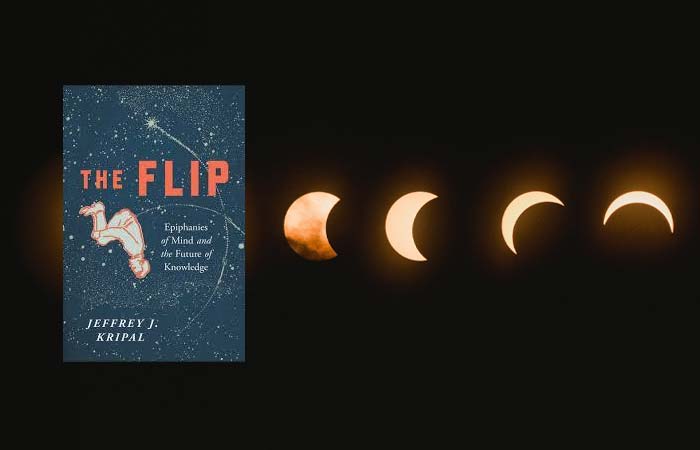

What is ‘the flip’ that Jeffrey Kripal speaks of? It’s a reversal of perspective that even committed, well-trained professionals experience when they suddenly realize they are not an ‘object’, but a ‘subject’. A few of the hundreds of examples that Kripal has collected are described in the book. One example is that Srinavasa Ramanujan (1887-1920) “attributed his mathematical discoveries not to any simple cognition or problem solving, but to his family deity, the goddess Namagiri of Namakaal, who would write formulas on his tongue and bestow mathematical intuitions in his dreams.” The way Ramanujan’s mathematical discoveries came to him, in his imagination, clearly don’t fit into our current materialist model. We look at ‘imagination’ as an expression of the unconscious, yet we lack a theory of what is doing the projecting of the story. The ‘story’ is difficult to study with science. Kripal asks ‘Can we build a model that explains both our ordinary and our super-selves?’
Jeffrey Kripal hopes that this book will initiate a deeper conversation between scientists and humanists, and argues for the centrality of the humanities in the discussion. Surely a meaningful model of reality would include both what scientists and humanists have to say? Neither succeeds alone. Interestingly, Kripal does not argue for one absolute, but for taking a third path, living in a particular story depending on what wants to do well. He states that no story, however ‘sacred’ or ‘scientific’ can speak for all earthly or cosmic life.
One of the outcomes that Kripal hopes for is an acceptance that uncertainty and indeterminacy are woven into the very nature of things. Kripal reminds us that both scientists and sages have spoken of indeterminacy, including Nobel-winning physicist Niels Bohr. Legendary Chinese Buddhist monk and poet Han Shan gives an allegory that resounded strongly for me: “As one suddenly comes out of darkness, I perceived the full meaning of immutability and said: ‘Now I can believe that fundamentally all things neither come nor go.’ I got up from my meditation bed, prostrated myself before the Buddha shrine and did not have the perception of anything in motion. I lifted the blind and stood in front of the stone steps. Suddenly the wind blew through the trees in the courtyard, and the air was filled with flying leaves which, however, looked motionless, …When I went to the back yard to make water, the urine seemed not to be running. I said: ‘That is why the river pours but does not flow.’ Thereafter my doubts about birth and death vanished.”
Among the concepts Kripal focuses on in this book is the importance of recognizing the difference between the subjective or ‘inside’ of reality that mystical experience gives insights to, and the objective ‘outside’ of things that our senses and scientific equipment usually tells us about. Neither the humanities nor the sciences has the full picture. Jeffrey Kripal joins other thinkers in arguing for a philosophy of mind that understands consciousness as both primary and more importantly, prior to brain function.
In The Flip, Kripal encourages readers to use the tool of personal experience to look at consciousness. Embracing personal experience influenced by Kripal’s explanations has been fruitful to me. For example, in Chapter 4, Kripal presents a partial list of the coinciding features between the ‘inside’ and ‘outside’ of mind and matter, including mystical experiences of light, the simultaneous existence and non-existence of space and time (which Han Shan described), and the ‘block universe’ hypothesis of modern cosmology. Like so many people, I have had mystical experiences involving light such as those described by Kripal. While reading The Flip, I took note for the first time of the interior experience of light that I have had all my life between waking and sleeping. I have seen, and still do, see wisps of light against a black background, pulsing slowly towards me, from a source in the middle of whatever inward place it is that I see. As I read the book, for the first time, I wondered if there was something to be gained by paying closer attention to these interior experiences of light. How I attended to it altered my experience: I experienced the wisps of light being blown away as if by a breeze, exposing the top of a metallic-colored sphere faced with hexagons. I don’t yet know what to make of these interior experiences, but I am much more comfortable with that ambiguity. Like Han Shan’s water that is both moving and not moving, I both do and don’t experience interior light. The light I see both inside and outside of my mind may be expressions of cosmic Mind.
Interviews

Artificial Intelligence and the Evolution of Consciousness
Interview with Steve McIntosh
Presence Cannot Be Simulated
Interview with Charles Eisenstein
Beyond the Creative Glass Ceiling
Interview with E. J. Gold and Claude Needham
“I Feel Responsible”: The Challenges of Bringing AI to Ethiopia
Interview with Mekdes Asefa
AI and the Future of Our Classrooms
Interview with Amy EdelsteinBook Reviews

A Summary of the Fetzer Institute’s Sharing Spiritual Heritage Report: A review by Ariela Cohen and Robin Beck
By Ariela Cohen

Choosing Earth, Choosing Us: Book Review of Choosing Earth
By Robin Beck

Everything, Everywhere, All at Once: Movie Review
By Jeff Sullivan
Monk and Robot: Book Review of A Psalm for the Wild-Built
By Robin Beck