
The Artist of
POSSIBILITY
articles
Image
May 15, 2023

She Brings the Dawn

Interview with Diane Schenandoah
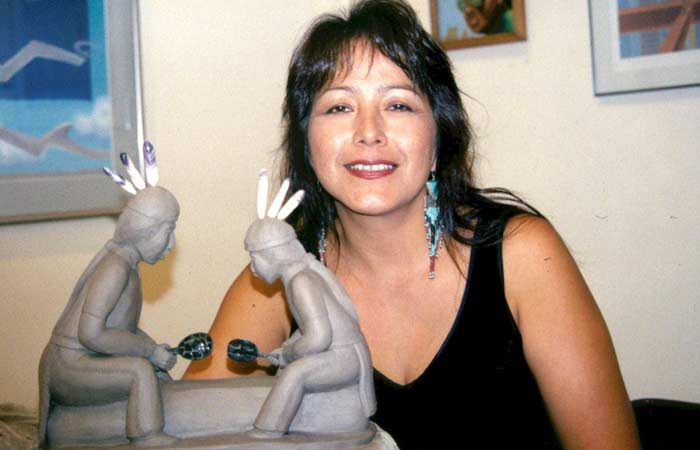
Amy Edelstein spoke with Diane Schenandoah, whose name is “Tekahnatshyali:te,” which in her language means, “She Brings the Dawn.” Diane is Oneida, of the Haudenosaunee confederacy and Faith Keeper of the Wolf Clan of the Oneida nation. She is also a sculptor, a writer, a teacher, and a singer. In this interview you will learn about her amazing life and the ways that she sustains the beliefs of her heritage.

Amy Edelstein: You’ve lived an extraordinary life. Will you share a little of your background and how you came to be the faith keeper of your tradition?

Diane Schenandoah: I have lived an extraordinary life. I feel very blessed. I grew up with my mother and raised my children on the traditional homelands of the Oneidas. It's actually referred to as the 32 Acres because this is the last bit of land that has never been seated by the Bureau of Indian Affairs. We've always held a title to it.

My mother was a Clan Mother. She was a little powerhouse. She was five foot two, and she commanded the respect of everyone in the community and was incredibly well loved. Many times I would come out of my bedroom in the morning, and there would be a whole family of four or five in the living room. My mother would be coming in the door with diapers and formula and she'd say, “Oh, they were just passing through and needed a place to stay.” That's the kind of generosity she always shared with the community.

My father was a jazz guitarist for Duke Ellington. We would go to Duke Ellington's home when we were little and play with the kids of other singers, that was cool. My sister [Grammy award winning] Joanne Shenandoah had the gift of singing. I remember Joanne was maybe six or seven on stage with my father and Duke singing “Autumn Leaves” or “September in the Rain” or something like that and she won the singing contest. When we were home together, Joanne would show me how to harmonize and we'd fool around on the piano.

After school I went out to Santa Fe to the Institute of American Indian Arts where I graduated with dual certificates, Associate Degrees in Three Dimensional Arts and Creative Writing. I did artwork out there for almost 10 years. Then, when I came home, I became my mother's assistant again. When I was younger I had been her assistant with all the meetings, the protocols , the teachings , and the ceremonies. We used to do energy work on people. Somebody would have a sore back or legs or whatever and we would work our energy around them. Being a faith keeper, doing the energy work came so organically, it's hard to describe even how it all came to be. I was so involved in everything that in 1988, the Wolf Clan asked me to be a faith keeper. Among the Oneida Nation, there are nine chiefs, nine clan mothers, nine female faith keepers, nine male faith keepers for each of the clan mothers and the chiefs. I'm one of three of the Wolf Clan faith keepers.

At the same time I was also doing my artwork, and my sister Joanne asked me to go sing at a concert with her in front of 15,000 people. My knees were shaking. I got up there on stage and played drums. I was incredibly nervous and scared! It was 1990 and we opened for Gordon Lightfoot. From then on, I just kept singing with her. My voice is so much lower than hers that our harmonies really blend beautifully. She had a daughter, Leah, who's also a singer, a very high soprano. Our first song together was so beautiful that we all cried. It was an Ojibwe song, in a different language. I've traveled around the world singing—we went to Istanbul and Italy and Germany, we went up to the Arctic Circle where I met natives from all of the different nations up there. I don't think there's a state that I have not been to in the United States other than Alaska. Pretty amazing.

Amy Edelstein: Now you hold a position at Syracuse University. What are you doing there?

Diane Schenandoah: Syracuse University created this position to help the Indigenous students at Syracuse University. My daughter and her husband were convinced I'd be perfect for the job. Of course, my resume was all about the art shows I've had around the world. They helped me share how I can help students from the things that I've gone through in my life. We have had very difficult political struggles in the territory where I grew up. Being in the position of the faith keeper, I had to maintain a certain amount of peace as we were battling the politics that could lead to extreme violence. I had a lot of experience in those types of situations and speaking with the press or talking to big crowds. I did four interviews for the position with students, administration, native students and the counseling center. They offered me the job!

It's a great job. I get to work with students. I get to carry out my own duties as a faith keeper and share some of our teachings.

I stress the importance of them being aware of the land that they're walking on. Do they know the history of the land? At a place of higher learning such as Syracuse University, this is exactly where this information should be taught. We should have learned it back in grade school or high school. There are different elements of indigenous histories that have been buried and swept under the rug because the United States government doesn't want people to know how badly native people were treated. Of course we all know there were smallpox blankets. But in New York state, our history has never been described from an indigenous point of view. The Sullivan-Clinton campaign went through the entire New York state and wiped out entire communities. Literally 90% of the native people in this country have been wiped out, 90%! Is that crazy?

Amy Edelstein: Can you describe how long have your peoples lived on the land?

Diane Schenandoah: Since time immemorial. Our origins don't have dates. Our origins are we come from the stars. How old are the stars? We are from the sky world. Sky Woman was placed on Turtle Island, on the turtle's back, at that time it was a very dark water world here.

Amy Edelstein: As you're teaching these younger people, what are some of the themes, values, and history that you feel are most important to pass on to them?

Diane Schenandoah: I think it is so key for young people to know how important it is to have love for themselves and to learn how to forgive. You cannot forgive unless you love yourself. Not in a vain way, but you love yourself enough that you're not going to be bothered by someone that did something to you. Therefore, you work on forgiving them, not for their sake, but for your sake, for your peace, to get to that point where you feel peaceful inside.

Now, we all have trauma. We all have generational trauma. Our children were stolen out of our homes and taken to boarding schools, had their hair cut, their identities taken away, and were punished for speaking their own language. When those types of things happen, naturally, there's generational trauma. We have young people facing that today. Their grandparents or their great-grandparents that went through all of this, although the policy ended in 1978, there were still some of these boarding schools run as recently as 2020. Those boarding schools have created tremendous trauma for us.

In order to move beyond that trauma, we need to be able to forgive. When you think about the people that came over in the boats from Europe and did this to our people, imagine the trauma that they carried with them. So there needs to be forgiveness on both sides. There needs to be healing on both sides.

How do you begin healing? You have to begin healing by being that love that you want to see and feel. That's how you begin that healing.

In our teachings we say that every peoples around the world have been given instruction on how to live. From Africa to Japan to wherever, all peoples were given these messages on how to live in peace, including the indigenous people. What happened around the Haudenosaunee people is, during a time long ago, we forgot those original instructions. There were great wars that broke out here, there was killing and destruction and cannibalism. It was bad. This is of course before European contact.

There was an evil chief named Tadodaho, who used to tie snakes in his hair to scare people. He was a cannibal, he would kill people, he was just horrible. We don't know why he got so awfully mean and horrible. Some say that he was abandoned as a child. Some say that he didn't have anybody to care or love him so he didn't think he was worthy of love.

There was a fellow named Hiawatha, who had seven daughters. Tadodaho wanted to marry them and Hiawatha wouldn't let him so Tadodaho ended up just killing all his daughters. Hiawatha was so full of grief, his heart was on the ground. He wandered for weeks and months through the mountains. He couldn't think, he couldn't talk, he just couldn't function. Hiawatha couldn't take the grief anymore and he wanted to end his life and threw himself into a lake. When he did that, the geese lifted the water away from him so he couldn't drown.

We say, “All things happen for a reason.” Hiawatha knew that his life was spared for a reason. He thought, “I need to find a way to have peace in my heart again.” He decided to create a ceremony, a grieving ceremony.

Some say that he made it out of wampum. Some say that he made it out of a cedar. He started creating a ceremony with these elements—with a shell or bone, and he started creating a belt. This is going to be the grieving belt.

With the first bead he created, he said, “This is going to represent the eagles because it's the eagle that carries all of our prayers and good deeds to the creator. If I was coming across anybody that was grieving as much as I am, I would want him to take the feathers from the eagle and brush the sounds of death from my ears so I'd be able to hear another person. I'd be able to hear the sounds of nature, of the brooks.”

Then he created another bead. He said “If I were to come across somebody grieving as much as I am, I'd want them to take the softest skin and wipe the tears from my eyes so I could see another human being. I'd be able to see all the beautiful creation around me.” Then he made another “That's going to represent water. I'd want somebody to hand me a drink of water to wash the slump from me.”

Now this story, mind you, takes a good 12 hours to tell–this is an incredibly brief version!

But anyways as he was doing that, they say the Peacemaker came down through the woods and asked him what he was doing. And the Peacemaker said “We're going to add one more bead to that and it's going to represent forgiveness. We need to be able to forgive. We can’t do any of this without forgiveness”

Hiawatha was so thrilled to hear about this that he shared it with the very first lodge. He was so excited he wanted to go and forgive Tadodaho for his evil acts. Tadodaho chased them all away and said he would kill him too. After Tadodaho chased them out, they went to all the other nations of Oneida and told them how we can achieve peace.

So many people wanted the wars to end, so they all went to Tadodaho as a collective. Now imagine that powerful energy coming towards you with thousands of people telling you that they loved you. They say that Tadodaho fell to the ground in front of them, he was just overwhelmed with so much loving energy. He accepted these messages of peace and they brushed the snakes from his hair. They say that he had seven hooks in his body. All the hooks were just so evil. They say that when they pulled the snakes from his hair, he came into alignment. I believe it's the chakras. A huge eclipse came into the sky.

That’s when all the nations of the Confederacy came together and decided to form the Haudenosaunee Confederacy. They would govern themselves under the principles of peace, through love and forgiveness. So that is our main great law of love and peace through forgiveness. They took all the weapons of war and put them underneath the white pine tree, so they wouldn't kill any more. And those are our principles that we live by today.

Amy Edelstein: It's a powerful story. It takes you on a journey and shows you how to see the world and your own resentments and hurts from a very different outlook. When the students you're working with come to you with their own grievances, whether they are issues about colonialism and the systemic racism that they've experienced in their own lives, or personal grudges, how do you help them internalize the wisdom of this story and practice a different way of being?

Diane Schenandoah: I'd say 98% of the students I see are seeking that peace. They're filled with turmoil or whatever they're going through and they're seeking that peace. Normally I start all of my sessions with students telling them that story I just told you.

I say, “People hold grudges and hate and anger over much smaller things than having seven of our daughters murdered. We say part of the reason that we come here to this earth is, you are here to learn lessons. Either you're going to meet somebody that'll teach you something, or you're going to teach somebody something. Even if it's just a smile, you're sharing that good energy.

Everything happens for a reason. There are no accidents, there are no coincidences. Everything happens the way it's supposed to. When you think about it, even the horrific things that happen around this world. Many times after 911 I've heard people say, “Oh the compassion, the humanity, the love that evoked, the coming together…” It's like something that tragic made something really beautiful happen, people coming together and sharing in that energy.

That is how I believe we're going to save this world–being that energy that pulls together and not having such horrific things happen. But they do happen. It's all a matter of who you want to be and how you want to see this earth. Be that person. Energy is contagious and we're energy. We're energetic beings. A plant is energy, everything comes from energy, and we're part of that energy. I show them different energy exercises that they can do to clear their own energy with sage and sweet grass, there's all these elements on earth.

One of the key things I try to share with them as well is the absolute importance of being grateful, having gratitude for everything. Gratitude for when you turn on a faucet, be grateful that clean water comes out. We’re very fortunate to have clean drinking water. People look at those elements as resources. They're not “resources.” They are relatives. They are part of us. We are 70% water or something like that.

I try to tell students about the importance that their presence brings here. They came here with incredible gifts. Every single person on this earth has some amazing gift that they bring with them.

Amy Edelstein: In the eastern traditions, there's a goal of Awakening or God Realization. You talked about how in your tradition, the highest goal is peace and love. What are the deep practitioners or Wisdom Keepers aspiring to realize? When you practice, what are you trying to cultivate?

Diane Schenandoah: Like I said, the most important element is love. If you love and have love within your family, I think that those things fall into place naturally—the behaviors, the practices, whatever it may be. But the most important element is love. That's a short answer to a big question.

Amy Edelstein: Beautiful. How are you pursuing your own wisdom? Are there elders you continue to study with?

Diane Schenandoah: Oh, absolutely. We just finished a lecture series with the clan mother from Onondaga. She did a four-part lecture series and I was one of the organizers for the students so naturally I was at every one. I never knew the history she talked about. There are just so many different little things that she shares, that you pick up and you're like, “Wow, I never knew that!” She'd tell stories about different animals that used to live in certain areas that are extinct now, or the history of how far the salt mines of Onandaga Lake extend. You just don't get this information anywhere other than from an elder speaking. I'm very fortunate and blessed that there are still those elders who are willing to share the things that they know.

Amy Edelstein: How are you trying to retain it all and share it with your students? Do you have students who are studying with you in an ongoing way so they can develop the memory and the language?

Diane Schenandoah: Actually, that's what I'm developing with Syracuse University. I've got a great team and we're constantly trying to bring indigenous culture and teachings into the school. It needs to be shared. It needs to be taught. I do Full Moon ceremony once a month and it's open to everybody, faculty, students, and staff. I hold it right there in the center of the quad at Syracuse University. We also have the Haudenosaunee Welcome Gathering, welcoming people from around the world into the capital of the Haudenosaunee, in the Onandaga Nation Homeland.

Almost the entire city of Syracuse was all original Onandaga nation land. It got sold illegally, and part of it became Syracuse University. Syracuse University has made great strides in helping the indigenous. They have an amazing scholarship program for Haudenoshonee students. They've acknowledged where they're seated and the importance of our history and culture. But if you have ever flown into Syracuse, New York, there isn't a single word that says native people are alive and still live here. All of New York State was Indigenous land. Then it was taken over. The Oneidas were guaranteed 5.5 million acres from George Washington for joining him in the American Revolutionary War. That 5.5 million acres were all illegally sold and dwindled right down to the 32 square acres that we live on now.

Amy Edelstein: I’ve heard about the land grab but hearing it from you was different. When we first met and you told me that story in all its detail, it really affected me—a people peaceably inhabited an area for 14,000 or 20,000 years or even more, then were “granted” land they were already custodians of, and then had that whittled down to a postage stamp of 32 acres. That's a hard fact and real.

Diane Schenandoah: Then to top it off, we had one of the most powerful land claims and our case went all the way to the Supreme Court. We lost the case in 2005. Ruth Bader Ginsburg wrote the decision. She later said it was the one decision she most deeply regrets. She cited the Doctrine of Discovery which comes from the Catholic Church. That says that any lands that Europeans come across if the people there are not Christian, you have the right to own the land and kill them. We indigenous people were considered part of flora and fauna. We were not considered human beings. Just recently the Pope issued an apology for the Doctrine of Discovery. “Oh, we've murdered and killed over 10,000 of your kids. Whoops. Sorry.” That's how that felt.

Amy Edelstein: This is an important context for people to understand and grapple with in order for real reparations to be made.

In addition to being a Faith Keeper, an activist and a healer, you are an artist. This magazine is called The Artist of Possibility, which seems very fitting to your work. What is the spirit that moves you when you create? Do you have a vision of what is coming forth?

Diane Schenandoah: To be honest with you, it shows me. It shows me every time. I can start off and I don't have an idea of what I'm going to do.

I love to do mothers and babies. I have five children, so I love doing mothers and babies. To me, it's very precious. I also love sharing my culture through my work. I love depicting different elements of who I am and where I'm from. Sometimes I create pieces that are very contemporary. I was very blessed, very honored to work with an artist named Jane DeDecker, who created the “Ripples of Change” monument to women’s suffrage at the museum in Seneca Falls. I was initially hired as a consultant and she said, “Diane, I would just love your energy on this piece.” I've always wanted to do monumental sculpture my whole life, and that was a dream realized when I was there working on this nine-foot bronze sculpture of Laura Cornelius Kellogg.

Amy Edelstein: What would you most like our readers to take away with them? What's your wisdom for everyone who might have been introduced to your tradition for the first time through this article?

Diane Schenandoah: My wisdom is always to remember to be grateful. Start your day out with gratitude, start your day out with everything that we've been given, including the elements, everything that we have. And also remember to say thank you to ourselves. Thank you for the work. Thank you for things that we can do for our fellows. We're all of the same marriage. We all need each other. We need to take care of one another.

Amy Edelstein: Thank you so much for sharing this window into your understanding of spirit and how it moves you. Thank you for all the work you're doing guiding young people and for your art, which has a very tender quality to it. My deep gratitude for you.

———–

  1. https://www.npr.org/2021/11/27/1059526800/musician-joanne-shenandoah-a-powerful-voice-for-native-culture-dies-at-64
  2. https://time.com/6177069/american-indian-boarding-schools-history/
  3. Robert J. Miller, “The Ten Legal Dimensions of the Doctrine of Discovery: The International Law of Colonialism,” Doctrine of Discovery Project (27 July 2018), https://doctrineofdiscovery.org/the-doctrine-of-discovery-the-international-law-of-colonialism/. “City of Sherrill v. Oneida Indian Nation of New York.” Oyez, www.oyez.org/cases/2004/03-855. Accessed 10 May. 2023.
  4. https://www.forbes.com/sites/chaddscott/2021/10/11/ripples-of-change-monument-in-seneca-falls-ny-shares-overlooked-stories-of-suffrage-movement/?sh=7d7b38771650

Interviews

Book Reviews

Essays

Book Excerpts

Featured Artists