
Thirty-five years ago, I had the good fortune of studying English Literature at the graduate level at the University of Virginia, where I had also studied as an undergraduate. The UVA English Department enjoyed a national reputation and boasted a number of top scholars among its faculty, of whom one of the most celebrated was Richard Rorty, who had been lured away from Princeton following the 1979 publication of his groundbreaking work, Philosophy and the Mirror of Nature. After a sabbatical year as one of the first recipients of a “genius grant” from the MacArthur Foundation, Rorty joined the UVA faculty in 1982 as the Kenan Professor of the Humanities, an inter-disciplinary appointment that well suited his wide-ranging intellect and interests. Although considered one of the leading philosophers of the late twentieth century, Rorty apparently felt more at home among literary types and so maintained his office at Wilson Hall, then the seat of the Department of English Literature.
Even as an undergrad in the early 1980s, I was aware of Rorty and his “rock star” reputation in the academy, but I had no occasion to meet him or study with him at that time – I was busy taking survey courses and fulfilling various area requirements to complete my English major, and a scholar of Rorty’s stature was not exactly teaching sections of Freshman Comp. However, when I returned to UVA to pursue my M.A. in the mid-1980s, I had numerous occasions to meet him. As a graduate student, I was permitted to use the faculty lounge, a comfortable refuge of bottomless coffee machines and overflowing bookshelves and tatty upholstered furniture where faculty and graduate students alike would gather to gossip and get caffeinated before their next round of teaching, reading or writing.
During these years I met Rorty several times in the faculty lounge or in the vestibule just outside the entrance, where he always greeted me with a smile and a friendly nod. Of course, he had no idea who I was (my area of focus was Romantic and Modern English Poetry, and so I never took any classes with him – to my everlasting regret), but I recall him always being extremely affable and gracious. Still, as a young grad student and intimated by his scholarly reputation – what could I possibly say that would be of interest to the greatest philosopher of our time? – I never mustered the courage to say more than a nervous “Hello” in response to his sincere greetings. Again, one of my major regrets from that phase of my life.
Although my own direct interaction with Rorty was thus limited by my poetry-oriented curriculum and personal insecurity, my more substantial interaction with the man and his thought came indirectly via his many grad students. In those days it was customary for graduate students in the humanities to meet on Thursday evenings at The Court Square Tavern, a quiet and extremely civilized watering hole in historic downtown Charlottesville, far removed from the boisterous student bars closer to the University Grounds. There, in a cozy atmosphere reminiscent of an English private club, groups of budding scholars would sit at polished wooden tables and pontificate while sampling the more than 100 types of beer imported from all around the world – this was considered quite exotic at the time!
I was a regular at these Thursday evening sessions, where I came to know many of my fellow grad students, not only from the English Department but also Philosophy and Religious Studies and other liberal arts disciplines as well. Our conversations were always wide ranging, as you may imagine, sometimes little more than petty speculating about departmental intrigues or venting our frustration with a stalled dissertation or difficult faculty advisor, but from time to time we would also discuss matters of substance. At these gatherings I met several grad students who had come to UVA specifically to study with Rorty, some even hailing from overseas. Whenever the conversation turned to Rorty, as it occasionally did, various questions from among his acolytes would be tabled and then get bandied about by the wider group: Was his best work behind him? Was he “selling out” by starting to write pieces for mainstream publications rather than focusing on rigorously argued articles for the professional philosophy journals? Was he getting a bit too comfortable in his emerging role as a public intellectual? And what’s up with his forays into literary criticism and political theory?
Around the table sat traditionalists, relativists, modernists, post-modernists, existentialists, deconstructionists, structuralists, post-structuralists, Freudians, Jungians, Marxists, and all schools of thought in between and far beyond, and debates about Rorty’s pragmatic philosophy – which held that no belief is more fundamental than any other and that philosophy therefore cannot establish anything and should be best understood as an ongoing conversation with the same sort of claim to finality as cultural and literary criticism – often raged late into the night. Is Rorty saying that there’s no difference between Hitler and Mother Theresa? How can Rorty deny the existence of objective reality when it’s staring you right in the face? Isn’t truth more than just description and language, as Rorty asserts – does saying that black is white necessarily make it so? And so on and so forth late into the night, in these somewhat more rarefied versions of a freshman dorm room bull session. No conclusions were ever reached for these questions (how could they be?), and strong opinions were often voiced by all sides on any particular issue, but I remember these Thursday evening debates as exciting and stimulating and lots of fun.
As I was familiar with Rorty’s academic reputation but unfamiliar with his actual work, I wisely kept my mouth shut during these occasionally heated discussions. However, inspired by the passion and wildly differing points of view expressed by Rorty’s students (and their interlocutors), and intrigued by their abstruse arguments over his subtle philosophical ideas (which were way over my head, especially after a few heavy Belgian beers), I decided to read his books for myself and form my own opinion. So I purchased Philosophy and the Mirror of Nature at the UVA bookstore and dove in.
To say that I almost drowned would be an understatement. While I could intellectually grasp a rough outline of Rorty’s central argument – that the mind should not be considered as a mirror to reflect an objective reality “out there” that exists separate from ourselves, with the role of philosophy being to keep the mirror well-polished – I lacked the necessary grounding in twentieth century philosophy to fully absorb and appreciate his sustained critique of modern analytic thought or to understand what he was proposing in its place. Wittgenstein, Heidegger, Quine, Sellars, et al. were names vaguely familiar to me but I was woefully ignorant of their actual work, as I was similarly familiar with academic concepts such as epistemology, philosophy of mind, philosophy of language (psycho-linguistics), and philosophy of science but was in no position to explain coherently the sophisticated ideas elucidated by these disparate branches of modern philosophy. Somewhat overwhelmed by the subtle nuances and deep complexity of Rorty’s arguments, however clearly and forcefully expressed in Philosophy and the Mirror of Nature, I retreated to the enchanting, inviting verses of Keats and Yeats, which to this English major were much more congenial!
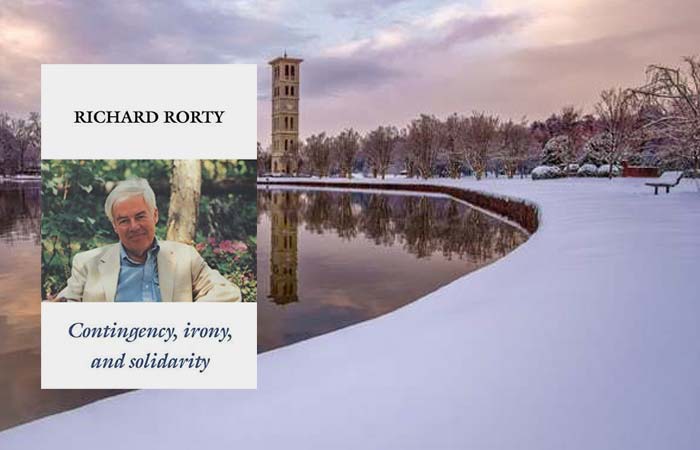
A few years later, however, still in grad school at UVA but having switched lanes from literature to law after earning my M.A., I decided to give Rorty another attempt by reading a slim volume published in 1989, Contingency, Irony and Solidarity. Although I was no longer a denizen of the Thursday evening grad student gatherings at The Court Square Tavern (law students had a regular Thursday evening gathering of their own, cheekily called “Bar Review”), I was still in touch with several of my grad student friends from Wilson Hall, many of whom were now completing their dissertations and receiving their hard-earned doctorates. Encouraged by their enthusiastic recommendations of Rorty’s newest treatise, I made yet another another trip to the UVA bookstore.
I found Contingency altogether more approachable, not least because Rorty drew on sources far beyond academic philosophy but also cited the work of writers and thinkers such as Nietzsche, Nabokov, Freud, Dickens, and Orwell, among many other poets and creatives with whom I was much more familiar. It is difficult to summarize this beautiful and thought-provoking (and quite provocative) little book, but its essence seems to boil down to the argument that we must see society as a succession of historical contingencies, that an ironic perspective on the human condition is valuable on the private level for dealing with these contingencies, and that on the public level we should look to the insights of great literature and not philosophy for guidance on the grand historical project of promoting human solidarity and eliminating cruelty and injustice in the world. As a litterateur and not a philosopher myself, I found this conclusion most gratifying.
Although I still struggled with many aspects of Rorty’s thought (certain themes remained elusive to my understanding, and I resisted a few of the bits I believed I understood), Contingency nevertheless championed important real-world goals that I could support and also suggested practical ways to incorporate specific ideas into my belief system and apply them to daily life – which for me was and remains the primary goal of any meaningful or serious study of philosophy.
There is a postscript, of sorts. A decade on, I was living in Prague and pursuing a career in business but still keenly interested in literature, philosophy and spiritual issues. By that time Rorty himself had moved from UVA to Stanford, where, completing his own evolution from iconoclastic philosopher to literary and cultural critic and budding political theorist, he had accepted in 1997 an appointment as, significantly, a Professor of Comparative Literature.
At the top of my reading list for 2001 was the Pulitzer Prize-winning The Metaphysical Club by Louis Menand. By coincidence, Menand had previously taught at one of my almae matres, the UVA School of Law (although, unlike with Rorty at the English Department, I did not meet him there), and I had been a big fan of his elegant prose and deeply insightful work ever since he started writing essays for The New Yorker in 1991.
I fully expected The Metaphysical Club to be absorbing and entertaining, which of course it was, but I had no idea how this highly accessible but weighty tome would enable me to tie together various threads of thought through its masterful portraits of Oliver Wendell Holmes, Jr., William James, Charles Sanders Peirce, and John Dewey, four disparate thinkers who concurrently (though not necessarily in cooperation) developed a distinctly American school of pragmatic philosophy. By becoming more familiar with these great American philosophers and their intellectual milieu and the historical and cultural circumstances that engendered their thought, I had a light-bulb moment and was finally able not only to ground myself in the rich and varied sources of the pragmatist tradition but from this deep place to connect the dots and trace an arc to the more mature and comprehensive philosophy that that Rorty was continuing to develop and refine one hundred years later. In short, Menand’s opus provided a necessary contextual background that had been previously lacking in my futile attempts to grasp the subtleties and appreciate the profound implications of Rorty’s revised and expanded version of modern pragmatist thought.
As I closed the covers of The Metaphysical Club back in 2001, I couldn’t help thinking, “If only I’d had this book twenty years ago, before struggling through Philosophy and the Mirror of Nature and feeling like a moron and a failure, I might have understood Rorty right off the bat and saved myself a lot of intellectual frustration and confusion!” But that’s all part of the journey, isn’t it?
Interviews

Artificial Intelligence and the Evolution of Consciousness
Interview with Steve McIntosh
Presence Cannot Be Simulated
Interview with Charles Eisenstein
Beyond the Creative Glass Ceiling
Interview with E. J. Gold and Claude Needham
“I Feel Responsible”: The Challenges of Bringing AI to Ethiopia
Interview with Mekdes Asefa
AI and the Future of Our Classrooms
Interview with Amy EdelsteinBook Reviews

A Summary of the Fetzer Institute’s Sharing Spiritual Heritage Report: A review by Ariela Cohen and Robin Beck
By Ariela Cohen

Choosing Earth, Choosing Us: Book Review of Choosing Earth
By Robin Beck

Everything, Everywhere, All at Once: Movie Review
By Jeff Sullivan
Monk and Robot: Book Review of A Psalm for the Wild-Built
By Robin Beck