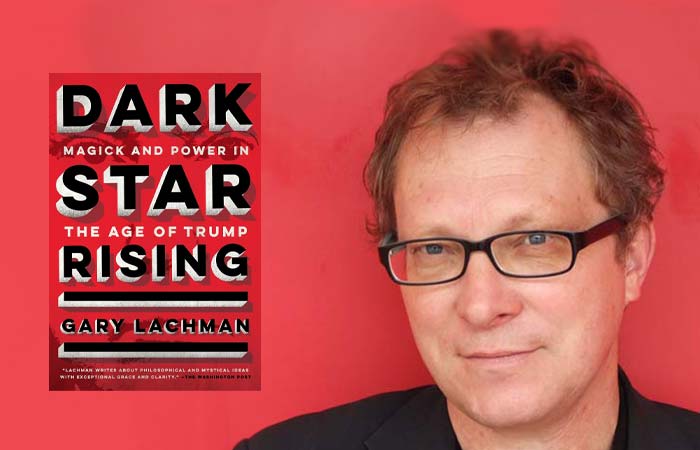
Jeff Carreira: In this issue we're exploring magic, mysticism, and the paranormal, and I wanted to speak with you because I've read your book, Dark Star Rising: Magick and Power in the Age of Trump and found it to be very eye-opening. Like most people, I habitually think of magic as something that used to happen in older times, or that people used to believe in during the Middle Ages or maybe still do today at the fringes of society. That isn't to say that I don't believe in magic; I do. But you think of magic as a more prominent part of the modern world than I had imagined. So, to start, I wonder if you would define magic for us?
Gary Lachman: Aleister Crowley famously defined magic as “the Science and Art of causing change to occur in conformity with will.” Later, Dion Fortune added to that by saying that magic creates changes in consciousness in conformity with will. Overall, I would say magic is the belief that there are certain rituals and practices through which the mind alone can alter reality or contact other agents that can. Traditionally, magic was often carried out by spirits, demons, or other entities. Of course, there is also what you might call natural magic, like Rasputin, who had the power to heal people.
Donald Trump was a central figure in my book Dark Star Rising, but in a broader sense the book is about a shift that has occurred in our cultural understanding of reality. I believe that with the Trump presidency we entered a time that has undermined the idea that we live in a stable, objective reality. For a long time reality has been thought of as something that actually exists as something separate from us, and that we can’t alter, no matter how hard we try. We can change real things, but not reality itself. This belief in a stable objective reality was fundamentally altered during the years of the Trump presidency. The idea of magic as something that only exists at the margins of society or was believed in during the distant past by our deluded ancestors has shifted to become a new center of activity for many people.
Donald Trump was a devoted student of positive thinking and the teachings and ideas of Norman Vincent Peale, who wrote the enormously influential book The Power of Positive Thinking in the 1950’s. That book presented a more or less Christianized version of the idea that thoughts are things and that you can use the mind alone to alter reality. Donald Trump was brought up with this idea, and there were many reports around his first presidential campaign that his supporters were somehow using magic on the internet to help him get elected. If this is true, then it is a form of chaos magic. And in saying this I don't in any way want to stigmatize any chaos magicians out there, but is does seem to me that it was happening.
So, we have Donald Trump practicing positive thinking, his supporters supposedly using magic to get him elected, and an academic and social cultural context where there is a growing belief that reality is unreal, or at least up for grabs and malleable. You talked about magic in the modern world, but I would say this is about magic in the post-modern world.
We seem to now live in the post-everything world where we what to get rid of every solid and fixed truth. We’ve come to understand that reality with a capital R, and truth with a capital T, don’t actually exist in the way that we thought. Even in science and quantum physics this idea is being reinforced via the uncertainty principle and indeterminacy. And then in popular culture everyone seems to be watching reality TV shows during the last few decades. Reality shows make representations of reality that seem to be more popular than reality itself. On top of all this, we live in a time of conspiracy theories where there's less and less faith in any authority. To summarize, magic has become more prominent in our society because a cultural belief space emerged in which magic seems possible again.
Jeff Carreira:The central figure of your book happens to be Donald Trump, but the book expands beyond him to explain how magic is being utilized in politics on all sides. And I assume you mean consciously using magic to influence the outcome of events, not just people using it unknowingly. I wouldn’t have thought of something like The Power of Positive Thinking as magic before reading your book; I would have thought of it as more of a psychological practice. When I read your book, I realized that in a broad sense it is a form of modern magic. Positive thinking is not just attaining different results with a better attitude; it’s about influencing reality itself.
Gary Lachman:There are many similarities between positive thinking and the aims of and approach to chaos magic (again, not to stigmatize chaos magic). The practice of positive thinking is aimed at a realizable wish, and chaos magic is aimed at an achievable reality. They’re both goal oriented, and both seek to make something happen.
Chaos magic is a revitalization of the older kind of magic, and seems to have originated in the mid-seventies right here in London around the same time that punk music was popularized. And chaos magic is do-it-yourself magic, like punk was the do-it-yourself music.
People were getting tired of the magic of the late 19th and early 20th century, with its secret societies like The Hermetic Order of the Golden Dawn. In those days, magic favored a more mystical approach. It was about gaining knowledge and having conversations with your holy guardian angel, your higher self or your true self, and variations on that theme.
People started getting tired of all that, and they wanted more stuff to happen. They wanted money to arrive in the mail, or wanted to be able to do something about that neighbor they didn’t like. They wanted to change and influence things in reality.
Changing things is the same aim that positive thinking has. Norman Vincent Peale was schooled in the older forms of New Thought, like Ernest Holmes and Ralph Waldo Trine. New Thought goes back to Ralph Waldo Emerson, the great American essayist, who coined the phrase. And later William James, the great American philosopher and psychologist and early explorer of mystical states, was into the idea of New Thought too because he understood that how you think influences what becomes real.
The early days of New Thought were more focused on health, and only later did people start to use the same principles to affect their wealth and prosperity, but it operates very simply: you make a mental image of something that you want to happen. It needs to be something that actually can happen.; it can’t be utterly impossible. It must be something that could be achieved by normal means. Once you have the mental image, you think and focus on it. You think about it so much that you push it down into your unconscious and act as if it's already happened. You reflect a different reality until it appears.
Jeff Carreira:You mention Neville Goddard in your book, which lead me to his writings, and there was one story he shares about his mentor that I found very impactful. It seems that Goddard told his mentor that he wanted to go on a trip, but he couldn’t possibly afford it. His mentor tells him to think about it as if it has already happened, and then forget about it and it will happen. Goddard doubts it will ever happen, right up to the last moment when it does. Afterward his mentor says that it only happened because he, the mentor, had faith that it would. Goddard himself was full of doubt and would have killed the possibility on his own.
What struck me about that story is that I tend to see those events from a psychological point of view, meaning that you put something in mind and then you think about it so much that it affects your behavior unconsciously, so that what you think about is attained. But that story, and your book, made me want to think purely in terms of magic without assuming any kind of unconscious drivers of behavior. I started to think in terms of the possibility of the spontaneous realization of intention – intentions so deeply implanted into the fabric of reality that reality itself conforms to them.
Gary Lachman:In the book I define magic as induced synchronicity. Carl Jung’s idea of synchronicity is that they are meaningful coincidences. With synchronicity there is typically something very important going on in your life, and suddenly you see something in the world that is an exact reflection of it. That occurrence is so obviously meaningful to you that it seems there must be someone or something who is aware of your situation and sending you a message. And so, I would say that magic is a way of deliberately making those kinds of synchronicities happen. Jung himself didn't like the idea that we could induce synchronicity because it sounded too much like magic, and he probably wanted to protect his career as a scientist. But I would say this is a great definition of magic: Magic is induced synchronicity.
Jeff Carreira:Thank you for that wonderful definition. I happen to know that your introduction to magic came by way of Aleister Crowley during the 1970’s when you were playing in the rock band Blondie. Can you tell us a little about your initiation into magic?
Gary Lachman:I started playing in Blondie in the spring of 1975 when I was all of 19 years old. At one point we all moved into a loft space in the Bowery section of New York City, and the very flamboyant artist who rented us our floor was into Crowley. I was never into any of that stuff before, the only kind of occult and supernatural stuff that I was into were horror stories like those of H. P. Lovecraft. I always read a lot. I read Jung, Herman Hesse and Nietzsche, but I wasn't into the occult. But this artist was a fascinating character, and he would do impromptu readings and painted canvases based on Crowley’s tarot deck. There were copies of books lying around like Crowley’s Diary of a Drug Fiend, and that was a gateway book. People who were into drugs would read that one and then get into magic.
I also read another book called The Occult by the British writer Colin Wilson, who had the most influence on me. I wouldn't be living here in England, and I wouldn't have written my books if it wasn't for him. What was fascinating about his book was how he looked at the occult in terms of the philosophy of consciousness. Wilson got started in the 1950’s with the publication of his first book The Outsider. That book was all about the stress and strain that is experienced by alienated creative individuals living in a world without meaning. He talked about Hesse, Nietzsche, Jon-Paul Sartre, and others. His writings about the occult were all in the context of this kind of philosophy, and he was just such a wonderful writer.
I got completely carried away and enthusiastically started reading about the paranormal and everything else I could find. It was a great time to do this because there were cheap reprints in the public domain available of so many classic books that even a starving would-be-rocker could afford. I wrote a song during that time called (I'm Always Touched by Your) Presence, Dear that came out a few years later and was a big hit in the UK and Europe. It was about experiences of telepathy and shared dreams that I was having with my girlfriend at the time. So, you can say that all the writing I'm doing now and have been doing for over 20 years started back then.
Interviews

Artificial Intelligence and the Evolution of Consciousness
Interview with Steve McIntosh
Presence Cannot Be Simulated
Interview with Charles Eisenstein
Beyond the Creative Glass Ceiling
Interview with E. J. Gold and Claude Needham
“I Feel Responsible”: The Challenges of Bringing AI to Ethiopia
Interview with Mekdes Asefa
AI and the Future of Our Classrooms
Interview with Amy EdelsteinBook Reviews

A Summary of the Fetzer Institute’s Sharing Spiritual Heritage Report: A review by Ariela Cohen and Robin Beck
By Ariela Cohen

Choosing Earth, Choosing Us: Book Review of Choosing Earth
By Robin Beck

Everything, Everywhere, All at Once: Movie Review
By Jeff Sullivan
Monk and Robot: Book Review of A Psalm for the Wild-Built
By Robin Beck