The Artist of
POSSIBILITY
Magazine
Image
January 15, 2020

Flow and Chinese Philosophy

A book review of Tying Not To Try

In my review of Steven Kotler's book The Rise of Superman, we looked at a Western psychological conception of flow. Now, we will explore a more Eastern conception on this topic; one that has been articulated centuries ago in foundational texts of Chinese philosophy.

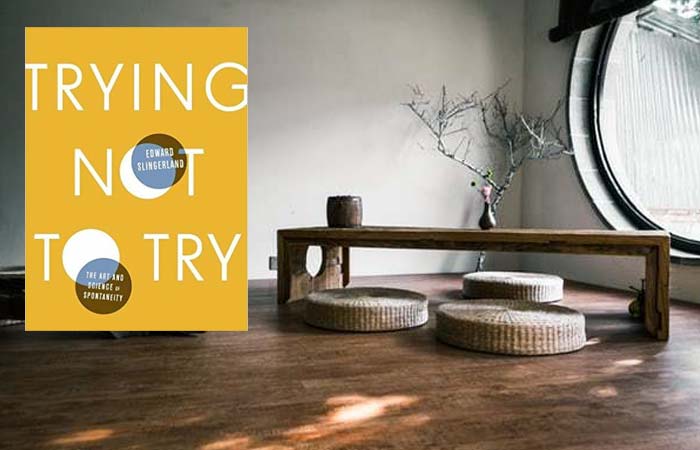
In this essay, we will take a close look at Edward Slingerland's book Tying Not To Try: The Art and Science of Spontaneity, with additional insights from an interview that we conducted with the author. Slingerland is a professor of Asian Studies at the University of British Columbia. One of his areas of concentration is Chinese thought and religious studies.

Let's start off with two concepts that are central to understanding Flow in Chinese philosophy: Wu Wei and De.

Slingerland describes Wu Wei as the effortless, unselfconscious ease of being that has an impact on how one relates to others. Indeed, Wu Wei, in its traditional understanding, has to do with being in line with the will of Heaven. It is the means by which one becomes a perfected human being who is embraced by others because of his or her ability to ground goodness and value in the world. De is the charismatic power that one exudes in the state of Wu Wei that is very attractive to others.

In our interview, Slingerland says:

Wu Wei literally means “non-doing” but a better translation is something like effortless action. It's a state where you don't have a sense of exerting effort. You don't have a sense of self-consciousness. You lose a sense of yourself as an agent and yet everything flows. Everything goes very smoothly, very effectively in the world. If you're in a social situation, you move through it very gracefully the whole time, without any feeling of doing something. It seems as if it just happens by itself. That's the state of Wu Wei.

The early Chinese think you get a certain power when in Wu Wei that they call De – unfortunately, it’s pronounced “duh” in Chinese modern Mandarin. It is usually translated as virtue, but it really means charismatic power. So, De is this power that you have when you're in a state of Wu Wei.

De is something we can actually see. You radiate De when you are in Wu Wei and when you're not, you don't. The Chinese have a religious explanation for that. They think that when you're in Wu Wei, you're in harmony with heaven. There's a supreme being in the universe that gives you De as a sign of its favor. It's a little like a star on your head that says “This is somebody we should follow, this person's OK”.

So, in the Chinese tradition, flow is seen as a way of being that is in line with a divine concept of social morality and that is often found amongst those that exude a certain je ne sais quoi.

Now, one may ask what the main differences are between the Western conception of Flow and the Chinese understanding of Flow. Slingerland clarifies this for us:

The Western views of Flow settles on complexity and challenge. That is, Flow is characterized by activities where we're constantly challenged and where the challenge gets greater as our skills improve. It's got to be a complex activity. That's what Flow is all about: Hitting that sweet spot of challenging your own skill level.

In the Chinese conception of Wu Wei, the hallmark is being absorbed in something bigger than yourself and something that you care for or value. So, being absorbed into some kind of valued whole. And for the Chinese, this was a religious whole. It was a Tao; a way that is in line with the will of heaven. But I think for contemporary people, it could be a variety of different things. Any sort of framework where you get meaning.

So now that we have a better understanding of some Eastern views on Flow, how does one go about attaining such a state?

Well, according to Taoism for example, trying to grasp at this state is a sure way of losing it. In this tradition, it is believed that a person of highest virtue simply acts, but does not reflect, nor train, nor exert conscious control. Hence, Taoism dismisses the need for practice or ritual in order to attain Wu Wei, contrary to Confucianism.

Indeed, in Confucianism, it is believed that nobody is born with the refined casualness and gracefulness characteristic of Wu Wei states. Confucianism believes in the development of an intelligent spontaneity through ritual, as practice would eventually allow for cognitive control systems to become activated more naturally and effortlessly.

This is an interesting debate and one that Slingerland talks about in the following way:

When you're talking about Wu Wei in the Chinese context, you're talking about social and moral skills such as being a good person or being in the world in the right way and, when it comes to that, internal motivation is crucial. So, there's a distinction between skill and a technical craft and what we'd want to call virtue or spontaneous goodness.

And so, the kind of Wu Wei that is really cared about is this kind of virtuous Wu Wei where your internal state matches what you're doing on the outside; and it has to or it wouldn't be real.

That's the tricky thing because if you're not generous, you could imagine doing generous things to try to make yourself generous but it's hard to know when that transition is going to happen. When do you go beyond just going through the motions and actually start to feel the real emotion?

The Taoists would say that that transition never happens. They say that if you train, if you learn the ritual of being generous, you're just going to turn into this hypocrite who can go through the motions and never feel the real virtue. Taoists see this as an enormous problem. Their strategy to deal with it is to undo cultivation and rely on something inside you that can lead you into the right type of way.

In Confucianism, on the other hand, you can't be spontaneous until you've trained for a long time. This is the picture of Confucius at age 70, when he's trained in the ritual and trained in the classics to the point where he's internalized Confucian culture completely and then he can be flexible. He always knows how to adapt into a new situation. He even potentially can tell when it's time to change ritual or to continue observing a particular ritual. He knows because he's mastered the Confucian way. In this case, training is a strategy for cultivating spontaneity, but the spontaneity and skilled mastery only manifests once the training falls away.

So, there is a back and forth between trying strategies and not-trying strategies. I think that none of these methods ever wins because they influence each other to a certain extent. They depend upon one another, and each one is appropriate for different situations and different people and probably different life stages.

In any case, whether through practice or not, both Taoists and Confucianists believe that the ultimate attainment of virtue comes with the attainment of Flow. And Flow always implies the shutting down of mind (called the cold system) so that the body ( the hot system) can take over. Slingerland explains:

What Wu Wei represents really is the harmony of these two systems; when the cold system has properly reshaped the hot system so that it can now run on its own. It doesn't need conscious monitoring anymore. And so, you've become a generous person and you don't have to think about generosity, you don't have to stop and say “There's a person in need, I should be generous”. You just hand over the money or you do the generous gesture without thinking, and this is Wu Wei fashion. It's the Chinese belief that that's actually the most reliable type of person you want to be around. The person who has to think about it, or think about rules, or do calculations is actually not really virtuous.

The Chinese conception of flow opens up some interesting comparisons with ideas from other traditions, such as: 1) the similarities between De and spiritual transmission – the undeniable and palpable power that some spiritual teachers, saints and mystics have; 2) the debate surrounding the necessity of effort and practice in both the Chinese tradition and the Eastern non-dual tradition.

It seems that the experience of flow is a universal human capacity that has captivated the human imagination for thousands of years. The way flow is interpreted differs from one culture and one circumstance to the next and our interpretation of Flow affects what possibilities and human capacities it unleashes.

Interviews

Book Reviews

Essays

Book Excerpts

Featured Artists