
The Artist of
POSSIBILITY
articles
Image
February 15, 2023

Soul Friends: Part II – Exploring Mystic Resonance

Interview with Stephen Cope
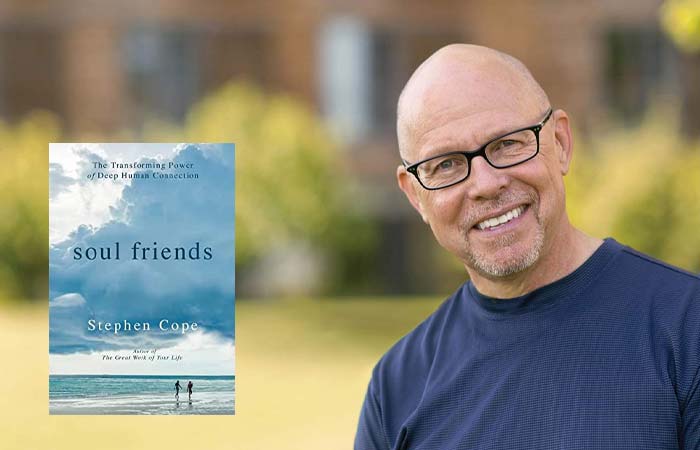
Stephen Cope is a Scholar-in-Residence, Kripalu Ambassador, and the founder and former Director of the Kripalu Institute for Extraordinary Living. He is a best-selling author of numerous books including: Yoga and the Quest for the True Self, The Wisdom of Yoga, The Great Work of Your Life, and The Dharma In Difficult Times. His work focuses on the relationship between the Eastern contemplative traditions and Western depth psychology. We knew that Stephen was someone we wanted to speak with as soon as the idea for the theme of this issue came up. His book Soul Friends, (published in electronic form as Deep Human Connection) is a powerful contemplation of the intricacies, challenges and triumphs of human relationship.

Jeff Carreira: We've been very excited about this interview because both Ariela and I had strong experiences of reading your book, although they were different, and so that seemed like it would be fun. Ariela’s interview is probably a great segue into the chapter on what you called mystic resonance that I read in the hardcover edition of your book called Soul Friends, but I noticed this chapter was omitted from the kindle edition. I found that chapter of the book particularly fascinating because I have had numerous relationships that I now recognize as examples of mystic resonance.

I have had deep relationships with many writers, most of which are not living anymore. Two that come to mind, both of whom were very influential in my life, are Ralph Waldo Emerson and Anais Nin. I read both of them in high school and I didn't understand either of them at the time.

Despite that, all through my life, I self-identified as someone who loved Ralph Waldo Emerson and Anais Nin. I was fascinated by them, as you said. And it wasn't until about 15 years ago that I went to a conference based on Ralph Waldo Emerson, and I just fell in love with him all over again and then I read everything I could. And a few years after that, Anais Nin came back into my life and I read her diaries and I thought, now I see why I was loving this.

So, I wanted you to speak first just a little bit about this idea of mystic resonance and the role that you think it plays in our spiritual growth.

Stephen Cope: When I experience that mystic resonance with someone, it's usually because they're working in the same spiritual territory that I am. They're excavating the same psychospiritual ground that I'm wanting to excavate.

Just like you. I have a huge library, but I have a special section that's for the books that I know I’ll have with me for the rest of my life. For example, Jean-Pierre De Caussade wrote a book called Abandonment to Divine Providence, and it's one of the most beautiful spiritual books you'll ever read. It foreshadows Eckhart Tolle because it's all about being in the present, but it was written in the 17th century. It's one of those books that I have where every sentence is underlined and that's because he's working on the same stuff that I am.

I have the same thing with Thomas Merton. I went through a Thomas Merton phase where I read everything that Thomas Merton wrote. It’s almost like devouring food; you're on the same wavelength. That's where the resonance comes in.

And similarly with Annie Dillard, I have a phase where I read everything she wrote and what's happening then is I'm learning from her. I'm vibing with her. I'm identifying with her. This is resonance. You recognize that they're working on the same developmental issue or spiritual issue that you are.

I use Bach and Beethoven as an example of it in my book. Beethoven was extremely talented and he couldn't find a teacher because there really wasn’t anyone who was equal to him. He studied with Hayden, who was the greatest teacher of his day, but it wasn't until he discovered Bach who'd been long dead, that he found the teacher he was looking for. Then for a period of time, Beethoven imbibed everything Bach wrote and started to write music the way Bach did. That's the process of imitation that occurs in mystic resonance.

Most often after a while you finish with one of these authors. You’ve eaten the meal and taken them in. If I read Merton now, or Dillard, they don't light me up nearly as much. I've moved on to something else. I think you have to constantly be scanning to discover what it is that's calling you and lighting you up right now. After a while, Beethoven moved beyond Bach, and then he started sounding more and more like himself, or like a version of himself that was influenced by Bach.

I'm in an interesting rather empty phase right now where there's nothing clear on the horizon that's calling me. Something will pop up if I pay attention. There are impulses to go back to those old authors, but it hardly ever really works. I've moved on to something else and I need to find that.

Jeff Carreira: I actually have pictures of some of my spiritual heroes up on my walls. They include Thomas Merton, Ralph Waldo Emerson, William James, Anais Nin, and, more recently, Fernando Pessoa. I live with them on my walls, their pictures and their books are everywhere.

Stephen Cope: This is a very common sign of mystical resonance, iconography. A central part of all spiritual practice is having exemplars. I strongly believe we all have our own corpus of saints.

There was a long period of time where I was praying to Jean-Pierre De Caussade, praying for his intervention. This little bald 17th century Jesuit priest. There are no pictures of him but I created one in my mind. I feel like I know exactly what he looked like, even though nobody does.

Jeff Carreira: I also feel like I have mystic resonance with some people who are alive today. I don't know if that's a different phenomenon or if it’s the same when it happens with a person who's embodied. But similarly, sometimes I meet someone and fairly quickly, I'll recognize that this is a connection I need to pursue. I don't know what it is, it feels energetically pregnant to me. And I feel it's offering me something on my own path of awakening. It doesn't always turn out to be the case, but often it does. In different ways they become very important relationships in my life.

Stephen Cope: Exactly. And you know what, Jeff, I've discovered that same thing, of course. And they can be either short-lived or long-lived. So I had one of these this year earlier, just before Christmas, with another wonderful man that I've known for 30 years, but recently we both had an intense desire to connect. He's 83 now and I'm 73. And we just got together for lunch.

He came an hour and a half toward me, and I went an hour and a half toward him. We had to get together and we did, we sat for three hours and had the deepest, most amazing conversation. And I will always love him, but I think that's all I needed.

So, it can be short-lived or longer. And it's important to know when you're done too, because we can hang on. And it's important to be able to say, okay, that's all I needed from that. Now I can move on. Because you have to be able to take that fresh energy and leave it open.

Jeff Carreira: That’s beautiful and it makes sense. The last question I wanted to ask you is: When I have these connections with people, it often feels to me like we have a connection that goes beyond this life. I think of these as a soul connection that extends beyond the date of our birth in this life and will extend beyond this lifetime on the other end. And I believe that there is an aspect of us that is our soul and it travels through multiple lifetimes.

I’m not sure how you relate to the idea of the soul or relationships that seem to exist at the level of the soul, but I was curious to hear your thoughts on that.

Stephen Cope: Well, I definitely believe that there is a soul that migrates, in concert with the way it is expressed in the basic tradition of yoga tradition. I also believe, with the Greeks, that there are two kinds of time. There's Chronos and Kairos. Chronos is linear time. Kairos is the eternal now. So, whether or not these lifetimes and these friendships have been alive over a trajectory of time and space, or whether or not they're just all happening now, is something I haven't really figured out. I don't have an opinion on it, although I do believe in the migrating soul. And, in a way, maybe it doesn't matter.
What do you think?

Jeff Carreira: Well, I love what you just said about the two kinds of time.

I’m always aware that there are more dimensions of my life than those I typically see, and I believe my actions here are having an impact on events in other dimensions, while simultaneously things happening in my life are being influenced by what goes on in other dimensions.

I think of a soul friend as someone who walks into my life and I immediately feel certain that we're connecting in more than one lifetimes, and on many dimensions. And that's why I feel a zing. You meet someone and you think you have so much in common with them that logically you should be friends, but that zing isn’t there. And then you meet someone else, and you don't seem to have much in common at all, but that invisible energy is so potent between you. When that happens I feel like I can't NOT pursue it because it feels like an opening from other dimensions telling me that there's something valuable to discover.

Stephen Cope: You're saying so many things here. First of all, in terms of the Kairos moment, I strongly believe something Thoreau said. He said, no matter how small the beginning, any act that is well done is done forever. And by that, what he meant was, when you bring everything to your dharma – that means your sacred duty or the action that you're called to do by your soul – then that act exists in Kairos time. It affects everything, the whole thing. Thoreau was very interested in the power of right action. And by that he didn't mean it in a moral sense. He meant it in an intuitive sense, meaning the action that's called for and evoked from the moment itself.

I write about this in my new book, The Dharma in Difficult Times. I’ve had the experience of an action that I took that I think was exemplary, healing all kinds of karma from past lives and affecting future lives. And I've had the experience of certain actions I've taken later in life that profoundly healed some deficit I had as a child.

It’s like when Lincoln signed the Emancipation Proclamation, it was a moment in time, but out of time, right? It lives in the ages. So, I relate to everything you're saying even though it's not something we commonly talk about.

Interviews

Book Reviews

Essays

Book Excerpts

Featured Artists