
The Artist of
POSSIBILITY
Magazine
Image
January 15, 2022

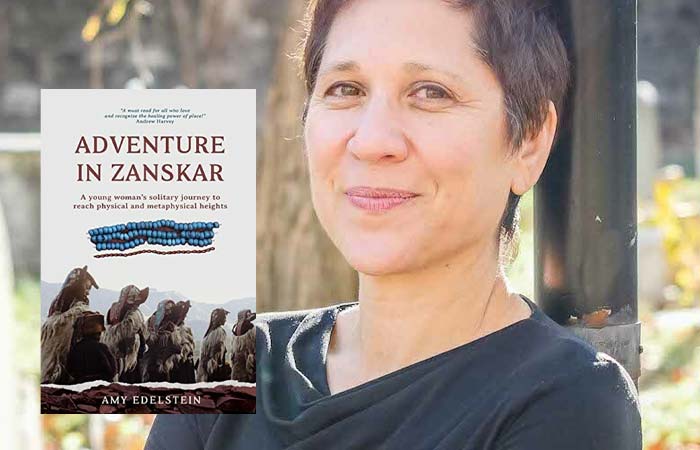
Adventure in Zanskar

An Interview with Amy Edelstein
Robin Beck: Amy, I'm so excited to speak with you about your book, Adventure in Zanskar. I got so much pleasure out of reading it, partly because personally I feel like I'm just emerging from a period of my life that you give voice to in the book. Coming out of my twenties and into my thirties I feel like I resonated with your journey in so many ways, and I found a lot of validation in my own path. And I'm just so honored to get the chance to speak with you about the book.To start, you mention in your foreword why you chose to write this book now, quite a few years after your journey took place. I was wondering if you could talk about why this book came into being now, given the context of the times that we're in.

Amy Edelstein: I'm glad to hear that it gave you validation on your own path. That was a lot of what I hoped in writing the book. It's a great story I wanted to tell, but writing it now, I really wanted to give people a sense that there is something worth questing for, and to take their own quest seriously. To value it, to appreciate it – even if it seems like it's meandering, haphazard, like you're not really doing it, or like somebody's already done it better in the past. I was hoping that this book would touch that part of individuals that is longing for meaning and longing for direction and longing for a sense that goodness is possible in this world.

I really felt that during COVID people became more inward, and for people who had a strong spiritual practice, they might have taken it easily. It was retreat time. It was simplicity. It was a time with less distractions. But for people who didn't have a strong connection to their own path or who suffered a lot of grief, it's been a difficult time.

I also live in a large inner city on the east coast of the United States. I know many of our readers are from all over the world, but the context in America over the last year and a half has been one of increasing strain on the wealth gap, and COVID exacerbated that. The whole issue of systemic racism and the harm that it continually does to a large proportion of our population is something I experience and I'm aware of on a daily basis. My non-profit works in inner city schools, and 80% of our students live in poverty, and about 70% of our students are of color. So I am aware of these issues in a way that, during some of my life, I was not so aware of because I lived more off-the-grid.

So I was experiencing the tension of these times, and my non-profit doubled in size. During COVID we were delivering 70 mindfulness classes a week, virtually, on computer to students. So we were extremely busy. We didn't increase in staff, we just increased in need. And for me, an outlet is writing. When I write I feel like I'm connected with something else. I've always written.

So I felt like it was time. It was time to give voice to this journey, and it was time to see if I could find a way to be true to the essence of 1983 so that people could get a sense of life when it was simpler, and of culture that was simpler. I also wanted to make it relevant to today, and have it speak to people in our era now.

Robin Beck: To start, summarize a little bit about the journey itself. What is the book about, and what does it say about your own personal journey?

Amy Edelstein: In 1983, I was in Asia. I had ostensibly taken a leave of absence from college to study in Japan and write a thesis on women's development in rural Japan. I flew to Asia and immersed myself in the traveler circuit. I got to Thailand. I had some adventures. Then I turned left and went to Burma, a country I didn't even know existed. Then I went to Bangladesh and Nepal, where I started practicing Buddhism and Hinduism and learning with different teachers. I spent the better part of 12 months walking in the Himalayas.

Adventure in Zanskar describes a two-month snippet of that time. I spent four years in India, but 12 months of that were really dedicated to walking in the mountains. And this was a journey that I took on my own, with a map. There were no roads. There were no Sherpas, or people to carry your bags. There were no tourist rest stops. There were no hotels. The area had just been opened to travelers in 1976.

If you don’t know where Zanskar is, you're not alone. It’s in the very Northern tip of India. Technically it’s part of India, but geographically it's the Western-most section of the Tibetan plateau. So it's a tiny area, very remote. It's a valley whose floor is 3000 meters high, which is higher than a lot of mountain ranges in the United States. And it just goes up from there. The area is ringed by jagged mountains that protect it.

And it had been a Buddhist valley, undisturbed, some think, since the second century. So it was Buddhist before Tibet became Buddhist, but now it practices Tibetan Buddhism. Previous to that the locals practiced the Bön religion, which has practices similar to what became Dzogchen in Tibetan Buddhism about the non-dual nature of existence.

I wanted to experience what it was like to be immersed in an environment where people were kind not because they were supposed to be, but just because that was the way they were. They lived in such a remote area that everyone depended on each other, so everyone had to get along. It's an area that was so steeped in the classical Buddhist tradition that I felt like it was one of the few places I could go to try and understand what I was learning about theoretically in meditation on retreats.

I was fairly new to the path. I started meditating in 1978, I read some books. I did a few short retreats, but I really didn't know very much at that point. And so I was walking, and wanting to understand my mind and questioning myself every step of the way. I didn't really have enough guidance, and I got ensnared by my mind quite often, which I write about in the book.

At one point I say that a little bit of Dharma, a little bit of teachings, is sometimes the worst thing you can have on the path because you think you know what the problem is, but you don't know enough to know what the antidote is.

Robin Beck: That inner conflict comes through quite often in your writing. You also directly observe the teachings of the postmodern west clashing with practices of Tibetan Buddhism. You write about being plagued with doubt and insecurity constantly, which is certainly representative of my own journey on the path, and seems to be common among westerners.

Amy Edelstein: I try to weave in multiple dimensions for the reader. So I was reflecting on culture. I was reflecting on Western materialism. I was reflecting on the negative impact I was having as a Western traveler in this remote area, because even though I had a relatively light footprint (I traveled alone, I didn't have a lot of expensive Western gear or money or an entourage) I still had my very clumsy Western ways. I was conscious of having an impact, and I explore that.

I also try to outline some of the history and conflicts, so people really get a sense of both the geography and the nature of the beauty, and the culture of the Dharma and what makes those people so special.

I wanted to weave these aspects in, partly because I think it appeals to different readers. There are the adventure travel readers, there are going to be the spiritual seekers like yourself, who identify with it. There are the Tibetan Buddhists who want to learn more about the area from my perspective. But ultimately, I chose these narratives because those are the dimensions that I always carried with me, and I wanted the book to be authentic to my journey at the time. I think that it's important for people to feel that a spiritual book can be read through different lenses.

Robin Beck: A common motif throughout the book is the kindness and generosity of the people of Zanskar, and how it differs culturally from the neighboring areas that you've traveled from. I really get the sense of a place that's stuck in time, and represents values that are being lost to the encroaching West.
You often comment on how the women hold themselves as equals to the men, like in the division of labor and raising of children.

Amy Edelstein: In Zanskar, no one is special, and everyone acts similarly. There wasn't some exalted Rinpoche or great monastics. The people display a sense of care and kindness. They have a gentleness that's also rough, and feisty and bawdy. They're sensual, and incredibly gentle.

Their gentleness was something that touched me so deeply, and it's really given me faith that the world can be different. I've been to some very beautiful places in my travels. I've been hosted by so many kind people in India, Bangladesh, Nepal, Thailand, Israel, South Africa… I’ve experienced so much generosity in my travels, but there was something in the culture and in the way of life in Zanskar that to this day gives me hope in what's possible.

I really want to share this experience with everyone, because we need that. We need to know that there was a living example within the last 30 years of a place to live that's harmonious, happy, and non-grasping. Sure, they can be competitive about horse racing and in the way that normal people can joke with each other, but still get along and live in deep harmony.

It's really possible. And it's possible not through external controls and endless laws and rules and regulations. We're so over-regulated in our country, and it leads to some very inhuman behavior, ostensibly to protect the vulnerable. But in the end, it makes us paranoid about our own human impulses towards care and compassion.

I understand why those rules are there, but they warp us in a certain way. The rules I observed in Zanskar had to do with the rules of karma: that you're setting good action in motion so that you perpetuate good action through your own karmic continuum. So a different way of living is really possible, and it's possible through sincerity and study, and just the right pillars of culture. This way of living touched me so deeply, and I'm forever indebted to them for opening their land to me, and grateful for me being born at the right time to be able to go.

Robin Beck: I'm curious, have you been back to Zanskar or do you know how it might have changed since the 1980’s?

Amy Edelstein: It's definitely changed. I have not been back, but as I was writing this book, I just started watching all the YouTube videos and documentaries that I could find.

They have since built a road through the area that I walked. Now there are all these travel blogs of young Indians describing how quickly they can cross it – within a day or so. Something that took me weeks. The documentary I was touched by the most was Journey from Zanskar, by Frederick Marx. It was narrated by Richard Gere, and it's a movie where they're taking something like 15, 20 children from as young as 3 and as old as 12 over some high mountain passes. They're not taking the same route I did; they're going south into Monali and sending them to schools.

And the reason why is because there are no schools in Zanskar, and the monasteries that used to educate at least one child per family have closed. And in the interviews with the people of Zanskar, they were talking about how poor they were, how illiterate they were, and how they had nothing.

And I just found that so sad, because they were so rich. They had beautiful wool clothing, and yak leather shoes that were lined with fur that kept them warm. And these girls on this expedition were crossing these mountain passes in thin cotton, factory-made Indian Punjabi dresses, and plastic boots made in India or China with no insulation.

You get the sense that the allure of Western materialism, of factory-made goods and petroleum-produced plastics, was superior to what they had lived on sustainably, that kept them warm for generations. They felt that they had nothing, and that the spiritual capital had been eroded so much. The monasteries used to educate at least one child per family, and then they would come back during the harvest time and they would teach everybody else. And that had been affected so much that I just found the whole thing a really sad account of how quickly modernization and globalization and Western scientific materialism (valuing that which you can measure and know over the esoteric arts) had eroded their culture so badly that people felt they had nothing.

Robin Beck: I wanted to pivot a little bit towards your own journey and the transformative process that you underwent, and how it seems fitting that one of the harshest places that humans can live on the earth is where you experienced the deepest transformation that you were looking for at the time.

Amy Edelstein: The land is amazing. It's very monochromatic: you've got stone, you've got snow, you've got water, you've got sky. And occasionally you have a little bit of greenery, but that's about it. And then within that monochrome landscape, there's tremendous variety.

So there would be days where I walked through an area that was literally black and white. They were black rocks, black mountains. I don't know much about geology, but it must have been some particular geological formation, and it was all black. And then you come out of that and then all of the sudden you're in these mountains that are striated, and lavender, and gold. There was sand color, and dark color, like the painted desert. But you just came out of this black and white scene, and you're wondering if you switched your lenses or something. I didn't have sunglasses, but you wonder if somebody changed the film in the camera from black and white to color. It was that dramatic.

And the rigor. Sometimes you were just walking along the base of the valley, and so you don't change elevation that much. And then other times you have to go up and down across these mountain passes. So you might climb a thousand meters up and a thousand meters down, and a thousand meters up the thousand meters down, in a day.

You can't really stop in the middle of the steep mountain. A few times I slept on the side of a glacier because I couldn't quite make it over – it was getting too dark. So I had to find a place to sleep that was safe enough. But mostly, you have to submit to the landscape.

And if that means you have to keep walking when you're exhausted, you have to keep walking when you're exhausted. And that means if you're paralyzed by fear, you still have to walk, because you can't stop in the middle of an ice bridge or in the middle of these unbelievable twig bridges.

Robin Beck: You described the joy that emerges spontaneously when spending time underneath the stars and, and these crescendos of awakening that you experienced across the journey that seem to come and fill you with rapture at times, and then leave you in this state of despair at moments. There’s a deep yearning for understanding, and knowing why you are experiencing what you're experiencing. There seems to be a desire to move past the doubt that seems to be plaguing you constantly, and I really felt this symbiosis in the way that the landscape itself seemed to invoke these states of mind within you.

It becomes clear as we progress through the book that you entered the valley with the intention of summiting a couple of key mountain peaks during your journey. And you summit one of these peaks, you experience a sense of awe, and you say that “my mind stopped. The fullness and treasure of it exploded in all my cells.” You find what you’ve been looking for. The sweeping landscape opens up to you, and speaks to you in a very sentient way. You have this wonderful period of self-acceptance where you don't need to climb that next mountain peak, where you don't need to figure yourself out. It’s like a puzzle that has already been solved on some level, and you watch your striving disintegrate.

I really appreciated that you didn't leave us hanging after this big climactic opening that you had, where the world was opened to you and everything resolved. You stayed with us and described the rest of your journey back into the world, and I found that very poignant.

At this point in your life, what would you say to your younger self? What would you say to an individual new to the path that finds resonance with your journey?

Amy Edelstein: I think that the main thing that I would say, both to my younger self and to anyone reading the book is: trust your own deepest experience. That's really what we have to go on, is our own deepest experience. And our own deepest experience may be deeper than what we're willing to acknowledge, or willing to give ourselves credit for. It may feel like “how dare we? How could we?” It's not something that anyone needs to speak about, but oftentimes we already know that we know.

And when you know that you know, you want to cherish that, and also protect it. Because there are a lot of people who will try to convince us that we don't know what we know. They will make us override what we already know, in the name of learning, or their own attainment or authority. And knowing is not a hard, fixed, cognitive knowledge that we hold on to, but it really is that sense of depth and unity and wholeness and goodness and presence and self.

And once we've had a glimpse of that, even if it feels like it was just a hairline crack, that hairline crack can be enough to give us an understanding. And that's what we want to cherish. There are plenty of things to learn. There are plenty of people to learn from, and there are spiritual psychologies that can really help with all those pitfalls of the mind.

I would say even in those moments of deep self-doubt, let yourself rest and trust that there's a certain place where we have already seen beyond it, even when we're in the throes of it. Allow yourself to draw strength and comfort from there, because you will get through those states of mind.

Robin Beck: I think that's a decent entry point into the work that you do now, and the Inner Strength Foundation. You mentioned a little bit about your work, primarily with inner-city youth in Philadelphia. I would be curious to hear more about how your work was influenced by your time in Zanskar, and what you hope to bring to a world that you’ve watched transform very radically since then.

Amy Edelstein: I work in the public school system. My non-profit has trained more than 16,000 teenagers in a three-month program we offer in the schools. Because it's public school and it's secular (and to be honest, the kids really are not very interested in India or high mountain passes), I don’t tell my stories in the classroom. I've tried, but those stories don't really have cultural relevance. Many of these students haven't really seen the forest. They haven't left Philly. They might have gone to the beach in New Jersey, but a lot of them haven't even gone to the suburbs where there’s woods and forest. So there really is no cultural bridge or interest.

But what I try to bring to them is that sense of their own innate goodness. The Zanskaris believe that everyone has Buddha nature. That's our inherent nature. They believe that our nature is inherent goodness, not original sin, and that we have the potential for Buddhahood in this life. If we strive for it, we can become awakened, and we can have no ignorance. And when we have no ignorance, then we don't act in ways that cause suffering to ourselves and other people unnecessarily.

There are of course all kinds of suffering associated with physical form, but there's suffering that's caused by bad motives, which is caused by ignorance because you don't realize the karmic effects.

That sense that we have goodness, and that we can attain a really profound level of human action and human heart, and that our lives can be happy, is something I really try to impart to them. Not by directly teaching what I learned and was exposed to, but by making those bridges and examples, and by holding space for all the complexity of their lives and helping them find stillness and centeredness and trust.

I did an assembly for something like seventy-five 11th graders yesterday. And at the end, I had them go around and say what they would wish for everyone in the room for the holidays; what good wishes do they want to send. About a third of them wished for safety. And that's telling. It's really telling that their concern, their hope for their classmates, for the people they love, is that they'd be safe. Both from COVID, but primarily from gun violence.

So it's an uphill battle. Not because of the kids. They're teenagers. So you got some disinterested, you've got some interested, but they're good kids. They're smart, perceptive, sensitive, creative, funny. But the environment that we've created is so hostile, and the means of destruction are so accessible. It's urgent that we teach our younger people self-regulation and emotional management, because right now a 15-year-old can pick up a handgun for a hundred bucks. And so instead of getting mad at somebody and breaking their nose, they could kill them.

We have a contract with the school district, and this year they asked us to work in some of the schools that were most impacted, where four or more students have died in the past year due to gun violence. You can imagine if you're in a high school of 800 kids, and you lose four of your schoolmates to violence, either intentional or random, it's going to make an impact. It's going to take its toll on everyone. You're going to feel it, and a lot of the kids say, “I'm just numb.”

Sometimes people say, “how is your program helping to alleviate gun violence?” Well, get the guns off the street! I'm teaching mindfulness. When I corresponded with one of our state representatives and said this, he just was speechless. He said that the climate is so hostile to sensible solutions that their hands are tied. And so we're turning to people like you, because we need to support these kids.

This is the kind of difficult world we live in. Now, I'm not cynical, but I am realistic. And I do believe that taking this experience of the primary nature of goodness, the primary nature of love, the primary nature of our capacity to live in harmony, and sharing practical tools that will help anyone will at least plant some seeds in people's hearts, like they planted seeds in mine. I believe a different world is possible.

I've spent 40 years of my life involved with doing this work. I want to change culture with this. I didn't just intend to help a few kids; I wanted to reach a significant number of young people so that people could grow up with a sense of different values and methodologies to calm afflictive emotions. I want to pass on these time-honored techniques and understandings of the way the mind works, the way that emotions work, and how to quell intense emotions. I want them to know the antidotes to greed and envy and retribution, and teach that so that we could see better-adjusted adults, who have that sense of a way to live from our higher nature, rather than be victim to our lower impulses.

Robin Beck: I would welcome that curriculum in the public schools that I attended. I feel like most of us go through our primary education without an understanding of how to treat each other. We teach so many other things than the basics about how to treat ourselves and others, and strategies to deal with emotions like anger.

In a lot of ways, this work feels like the fulfillment of some of the battles you allude to in the book. By the end of your journey, you have cultivated a willingness and desire to alleviate suffering for everyone, and that’s a value you have clearly shepherded into adulthood.

I know that the book itself will not be of interest or value to the vast majority of your students. But there will be gems, of course, that emerge and really do take this book to heart.

Amy Edelstein: Whether they see the book or not, I know that they do experience that. They do walk out of class with a sense that “oh, this was different. This was different than how things normally are.” I've seen amazing transformations. There are some phenomenal stories of really happy, forward-looking, curious, discriminating students. So, I've been very touched when I've seen my students out in the world. Sometimes they say, “I still do some of the tools you taught me!”, and tell me about the personal development they’re involved with now. And, usually, these students are someone who never would have been exposed to that kind of thinking otherwise, and is now pursuing that kind of positivity.

The sense of self-esteem, self-value, and that they're worth it is inspiring. They’re aware of their beautiful nature, and aware that it’s possible to cultivate it further so that it can really come to full-flowering. That comes through in the students’ writing, and they have really deep insights.
Robin Beck: That's the biggest reward.

Amy Edelstein: Yeah, definitely. Definitely for them, and also for their teachers. It’s great when I get to see the school teachers letting up just a little bit, because they've got an impossible job.

Robin Beck: I'm grateful for the work that you're doing as a positive example to all these kids, and also for your other books, writings and teachings.

And I'm so grateful to have an account of your journey in Zanskar. Being with you as I read the book was just a privilege, and I want to thank you for sharing yourself so deeply and so authentically.

Amy Edelstein: Thank you. Thank you so much for everything you said, it means more to me than you might think.

Interviews

Book Reviews

Essays

Book Excerpts

Featured Artists